| |
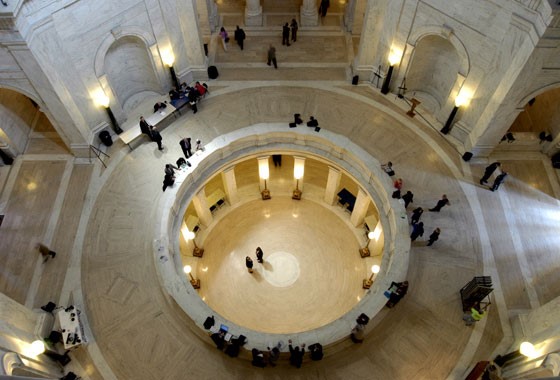
The Well is where conversations happen at the Capitol — where legislators, lobbyists, and staff compare notes, test the mood, and figure out what matters. This briefing is built the same way: a fast, disciplined read on what is moving in West Virginia government before the day begins.
ROTUNDA ROUNDUP
Early voting opened strong. Secretary of State Kris Warner said 16,584 West Virginians voted on the first day, 41% more than the comparable 2022 midterm. He said 17,000 new voters have registered since May and that the new photo ID requirement has drawn no complaints. In Cabell County, the commission named Magistrate Danne Vance county clerk in the middle of early voting.
School funding moved onto a second legal track. Berkeley County Schools formally notified the state it intends to sue over the aid formula. The district cites teacher-pay competition with Maryland and Virginia and a $38 million special education gap. Superintendents statewide blamed population loss and the Hope Scholarship for the 8,200-student enrollment drop, including a 14% loss in Roane and 933 fewer students in Kanawha. Treasurer Larry Pack said Hope is not the cause.
On state money, a Gazette-Mail records review found economic development officials pushed Clean Vision’s forgivable-loan deadline to March 2027. The company has reported a $54 million-plus deficit. A national fiscal watchdog gave West Virginia a B for the fourth straight year but flagged repeated federal-grant audit problems. Gov. Patrick Morrisey finalized more than $58 million in water and sewer packages, with IJDC votes Nov. 4. FEMA aid in flood-hit Upshur and Lewis counties passed $16 million.
On energy and data centers, the Senate set a Nov. 9 procedural vote on the bipartisan permitting overhaul Sen. Shelley Moore Capito co-wrote. President Trump said data centers must generate their own electricity, mirroring West Virginia’s microgrid law. Agriculture Commissioner Kent Leonhardt urged developers to keep data centers off productive farmland. A trucking group backed Morrisey’s dyed-diesel order, and Ohio adopted a matching one. The Lottery Commission will consider a $12,000 penalty against gaming provider Gamewise on Oct. 28.
WHAT MATTERS TODAY
More than 16,500 West Virginians voted on the first day of early voting, up 41% from 2022.
Warner said 16,584 voters cast ballots Wednesday, a 41% increase over the comparable 2022 midterm. About 17,000 new voters have registered since the May primary. Warner reported no complaints so far under the new photo ID requirement. This is the first election in which 16- and 17-year-olds may work the polls. Early voting runs through Oct. 31, with statewide Saturday hours from 9 a.m. to 5 p.m.
Why it Matters: Turnout in the first photo ID general election will help settle the legislative majorities that write the 2027 agenda.
What to Watch: Saturday turnout on Oct. 24 and Warner’s next early-voting report.
Source: WV MetroNews — More than 16,000 West Virginians take to the polls on first day of early voting — Read the story
Cabell County names Magistrate Danne Vance county clerk in the middle of early voting.
The Cabell County Commission chose Vance to replace former Clerk Scott Caserta, who retired last month. The county clerk administers elections, including early voting and absentee ballots.
Why it Matters: A leadership change in a large county’s election office during active voting puts a premium on a smooth handoff through the canvass.
What to Watch: Vance’s swearing-in and any staffing changes before Election Day.
Source: WSAZ — Cabell County Commission selects new clerk — Read the story
Additional Source: WV MetroNews — Cabell County Magistrate Judge Vance to become next clerk — Read the additional reporting
Berkeley County Schools gives notice it will sue the state over the school aid formula.
The Berkeley County Board of Education notified state officials Wednesday that it intends to sue, starting the 30-day notice period state law requires. Superintendent Ryan Saxe said the district cannot match Maryland and Virginia teacher pay and relies on more than 200 permanent substitutes. He said Berkeley spent $38 million more on special education than state aid covered. The board unanimously authorized the litigation June 1.
Why it Matters: It opens a second legal front alongside a Lincoln County student’s ACLU-backed Supreme Court petition. It also comes a week after the state Board of Education formally called the formula inadequate.
What to Watch: The notice period expires around Nov. 20. Watch also for House Education’s interim review of the board’s formula proposal.
Source: West Virginia Public Broadcasting — Berkeley County Schools To Sue Over School Funding Formula — Read the story
Superintendents blame population loss and the Hope Scholarship for the enrollment drop.
Roane County lost 14% of its students; 100 of the 230 who left after two school closures took the Hope Scholarship. Harrison lost 397 students, Calhoun 7%, and Berkeley nearly 400 despite 14% population growth. Kanawha lost 933. WVDE’s data director said the school-age population fell 4.6% from 2020 to 2025 while enrollment fell 7.9%. Treasurer Larry Pack said Hope is not to blame, noting more than 26,000 applications. This was also the first year students already in private or home school could apply.
Why it Matters: Enrollment drives state aid, so these losses become cuts and closures. House Education Chair Joe Statler is calling 2027 “the year of education.”
What to Watch: How lawmakers use the district data when they take up the Board of Education’s formula proposal at interims.
Source: West Virginia Watch — Population loss, Hope Scholarship driving enrollment losses in West Virginia, school districts say — Read the story
Additional Source: WV MetroNews — Kanawha County Schools sees 933-student enrollment decline since last year — Read the additional reporting
Morrisey administration extended Clean-Seas’ loan deadline despite financial red flags, records show.
Clean Vision Corp. received a $1.75 million forgivable state loan in 2023 for a plastics pyrolysis plant near Belle. The loan required 40 jobs and $50 million in investment by March 27, 2026. A May letter from the Division of Economic Development moved that deadline to March 27, 2027, according to records the Gazette-Mail obtained. Clean Vision has reported an accumulated deficit above $54 million and filed in June to stop SEC reporting. The Economic Development Authority says it has disbursed nothing from a separate $15 million loan approved in 2024. The division said the extension followed standard guidelines; the governor’s office has not said whether it supports the project.
Why it Matters: The extension raises questions about how performance-based incentives are enforced. It also adds a state-money angle to a DEP-permitted plant that residents oppose, sited less than 500 feet from Riverside High School’s entrance.
What to Watch: Whether lawmakers or the EDA revisit the incentive terms before the 2027 deadline.
Source: Charleston Gazette-Mail — Morrisey admin approved Clean-Seas performance loan reprieve despite red flags — Read the story
West Virginia earns a B for fiscal health, but audits flag federal-grant oversight problems.
Truth in Accounting gave the state a B for the fourth straight year. It found about $3 billion available after bills at the end of FY 2025, or $5,800 per taxpayer. Federal grants totaled $9.7 billion, 40% of revenue. The report said federal Single Audit reviews repeatedly found weak financial oversight, late federal reports and missing documentation, with some earlier findings unresolved. Unfunded pension liabilities fell to $539.2 million, while retiree health care moved from fully funded to $84.2 million underfunded. The governor’s office declined comment.
Why it Matters: The grade supports the administration’s fiscal message heading into budget season. The audit findings cover the end of the Justice administration and the start of Morrisey’s, and they are a liability as federal grant scrutiny tightens.
What to Watch: The next Single Audit and Morrisey’s January budget proposal.
Source: The Parkersburg News and Sentinel — West Virginia receives B for fiscal health in annual report — Read the story
Morrisey finalizes funding packages for more than $58 million in water and sewer projects.
The governor announced $4 million in AMLER money for a new Buckhannon water treatment plant. The $47.31 million project is otherwise funded mostly by $40.31 million in federal loans and grants. He also recommended $930,000 in IJDC grants to complete three projects:
- an $8.74 million water extension serving Justice and Hanover in Mingo and Wyoming counties
- a $2.525 million Salt Rock wastewater upgrade serving 4,855 customers in Ona, Milton and Culloden
- a Fort Gay water main extension
Why it Matters: The money targets flood-hit Upshur County and homes still on private wells, using IJDC grants to close gaps on federally funded projects.
What to Watch: The IJDC is scheduled to consider the grants and financing Nov. 4.
Source: WSAZ — Morrisey completes funding packages for more than $58 million in water and wastewater projects — Read the story
FEMA assistance tops $16 million in Upshur and Lewis counties after the July flood.
Federal aid in the two counties has passed $16 million since the July 21 flood and the disaster declaration that followed.
Why it Matters: Recovery money is still flowing three months out, alongside the new Buckhannon water plant funding.
What to Watch: Updated FEMA and SBA totals as applications continue.
Source: WV MetroNews — FEMA help tops $16 million in Upshur, Lewis counties — Read the story
Senate sets a Nov. 9 test vote on Capito’s bipartisan permitting overhaul.
A procedural vote to bring the Bipartisan American Affordability and Jobs Act to the Senate floor is scheduled for Nov. 9, Roll Call reported, and it needs 60 votes. The 417-page bill from Capito, Sens. Mike Lee, Sheldon Whitehouse and Martin Heinrich would change permitting under NEPA, the Endangered Species Act and the Clean Water Act. It would also limit how administrations can revoke permits already issued, and it would require state regulators to make AI hyperscalers cover their own power costs. The American Petroleum Institute and renewable energy groups back it. Environmental groups, tribes and some utilities have raised objections, and a manager’s amendment is expected.
Why it Matters: A rewrite of federal permitting law would directly affect West Virginia pipeline, transmission, coal and data center projects, and it puts Capito at the center of the lame-duck agenda.
What to Watch: The Nov. 9 cloture vote and the manager’s amendment text.
Source: Roll Call — Permitting bill writers seek industry aid ahead of Senate vote — Read the story
Trump says data centers must generate their own electricity.
In a Truth Social post Wednesday, President Trump said new and large data centers are “mandated” to make their own electricity and give or sell any excess to local communities or the grid. The Hill’s report did not identify an executive order or rule carrying out the directive.
Why it Matters: The approach mirrors West Virginia’s 2025 microgrid law, HB 2014, which lets data centers generate their own power. That alignment could strengthen the state’s pitch to developers.
What to Watch: Whether the White House or the Energy Department issues formal guidance or an order.
Source: The Hill — Trump says he’s requiring data centers to provide their own electricity — Read the story
Additional Source: WOWK — Trump says he’s requiring data centers to provide their own electricity — Read the additional reporting
Agriculture Commissioner Kent Leonhardt urges data center developers to avoid farmland.
Leonhardt said he supports economic development and respects property rights, but he called productive farmland a valuable and limited resource. He urged developers of data centers and other large projects to avoid it. He also asked that transmission corridors minimize disruption to farm operations and that affected landowners receive fair compensation.
Why it Matters: A statewide elected official is adding a farmland-protection marker to the data center and transmission fights ahead of the 2027 session.
What to Watch: Whether farmland protections surface in HB 2014 amendments or in PSC transmission cases.
Source: WV News — West Virginia agriculture commissioner urges data centers to avoid farmland — Read the story
Trucking industry backs Morrisey’s dyed-diesel order as Ohio adopts the same approach.
A trucking association said Thursday it supports the executive order Morrisey signed Monday allowing red-dyed diesel on highways. Ohio Gov. Mike DeWine signed Executive Order 2026-05D on Wednesday allowing the same on Ohio’s public highways.
Why it Matters: Matching orders on both sides of the Ohio River give carriers consistent rules while the broader fuel-tax relief debate continues.
What to Watch: Whether Morrisey adds tax relief or calls the special session Democrats are seeking.
Source: WV MetroNews — Trucking association supports governor’s decision to permit red-dyed diesel — Read the story
Additional Source: WSAZ — Ohio Governor DeWine signs Executive Order for use of dyed diesel on public highways — Read the additional reporting
Lottery Commission to weigh a $12,000 fine against gaming management service provider Gamewise.
A notice posted Wednesday for the Oct. 28 combined committee and commission meeting lists the director’s recommendation for the penalty. The notice says it is for a violation of the state’s minimum internal control standards.
Why it Matters: Enforcement against licensed providers signals the Lottery’s compliance posture as regulated gaming competes with federally registered prediction markets.
What to Watch: The commission vote at 9 a.m. Oct. 28.
Source: West Virginia Secretary of State — Meeting notice: WV Lottery Commission, Oct. 28, 2026 — View the official source
WHAT TO WATCH
- Early voting: Watch Saturday turnout Oct. 24 and Warner’s next report. Source: WV MetroNews
- Permitting overhaul: The Senate holds a cloture vote Nov. 9 on Capito’s bipartisan bill. Source: Roll Call
- School funding litigation: Berkeley’s notice period ends around Nov. 20, and the Lincoln County petition is pending at the Supreme Court. Source: WVPB
- Water and sewer awards: The IJDC votes Nov. 4. Source: WSAZ
- Gaming enforcement: The Lottery Commission decides the Gamewise penalty Oct. 28. Source: Secretary of State
- Senate District 13: Watch coverage of Thursday’s MetroNews debate in the Monongalia-Marion seat. Source: MetroNews TV
- Monarch air permit: Comments close Oct. 30. Source: WSAZ
DATES AHEAD
- Oct. 24: Saturday early voting, 9 a.m. to 5 p.m. statewide. WV MetroNews
- Oct. 27: IJDC Technical Review and Funding Committee, 9:30 a.m. Secretary of State
- Oct. 27: WV Parkways Authority, 10:30 a.m. Secretary of State
- Oct. 28: Lottery Commission, 9 a.m. Secretary of State
- Oct. 28: Judicial Vacancy Advisory Commission organizational meeting, 9:30 a.m. Secretary of State
- Oct. 28: Racing Commission, 10 a.m. Secretary of State
- Oct. 28: Absentee ballot request deadline. West Virginia Watch voter guide
- Oct. 29: Environmental Quality Board, 10 a.m. Secretary of State
- Oct. 29: PEIA and RHBT Finance Board, 1 p.m. Secretary of State
- Oct. 29: Board of Coal Mine Health and Safety, 1 p.m. Secretary of State
- Oct. 30: Monarch air permit comments due. WSAZ
- Oct. 30: Hope Scholarship Board Committee on Appeals special meeting, 10 a.m. Secretary of State
- Oct. 31: Early voting ends. WV MetroNews
- Oct. 31: Comments close on 36CSR22, the only state rule currently open for comment. Secretary of State
- Nov. 3: General Election Day. WV MetroNews
- Nov. 4: IJDC considers the water and sewer awards. WSAZ
- Nov. 9: Senate cloture vote on the permitting bill. Roll Call
- About Nov. 20: Berkeley County’s 30-day pre-suit notice period ends (calculated from the Oct. 21 notice). WVPB
|
|