| Opening Note
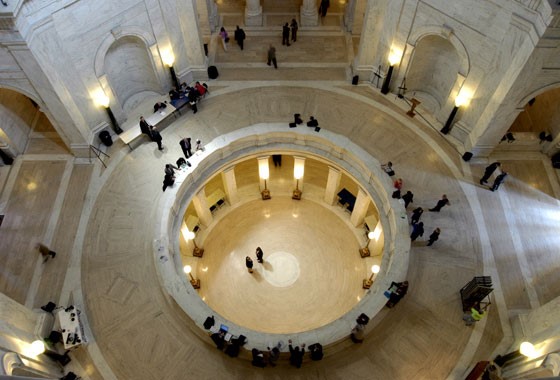
The Well is where conversations happen at the Capitol — where legislators, lobbyists, and staff compare notes, test the mood, and figure out what matters. This briefing is built the same way: a fast, disciplined read on what is moving in West Virginia government before the day begins.
Rotunda Roundup
West Virginia begins the week with three large policy questions converging: what the state is willing to accept to win a federal nuclear-development campus, how it will finance long-neglected water systems in the southern coalfields, and whether its public school funding formula can survive another constitutional challenge. New reporting shows the Morrisey administration’s nuclear bid went beyond general expressions of interest, emphasizing West Virginia’s ability to move permits quickly and identifying potential sites while accepting a federal framework that includes disposition of used nuclear fuel. At the same time, Southern West Virginia’s water crisis is colliding with the expiration of extraordinary federal infrastructure support, and a new Supreme Court petition could force lawmakers back into an education-funding debate they were unable to resolve during the 2026 session. Monday also brings an important PSC hearing on electric-generation policy and a scheduled U.S. Senate vote on federal college-sports rules.
What Matters Today
West Virginia’s nuclear-campus bid included potential sites, expedited permitting — and willingness to participate in nuclear waste disposition.
New Charleston Gazette-Mail reporting provides the most detailed look yet at what West Virginia offered the U.S. Department of Energy in its effort to land a Nuclear Lifecycle Innovation Campus. The state identified potential sites and emphasized its ability to move permitting quickly, while the federal initiative itself expressly includes reprocessing used nuclear fuel and disposition of nuclear waste. DOE says the campuses are voluntary federal-state partnerships covering the nuclear fuel cycle from fabrication and enrichment through reprocessing and waste disposition; West Virginia is one of six states now in contention. Muck Rack
The disclosure materially advances what was known when Gov. Patrick Morrisey announced the state’s memorandum of understanding with DOE earlier this month. Previous reporting established that the eventual campus could involve transferring control of host-site land to DOE, significant private and state investment, reactors, manufacturing, data centers and management of used nuclear fuel. DOE plans to narrow the contenders to final host sites by the end of 2026. WV MetroNews
Why it Matters: Nuclear waste disposition changes the political and regulatory stakes of the proposal considerably, particularly once prospective locations become known and host communities can evaluate what activities might actually occur there.
What to Watch: Disclosure of the sites identified in West Virginia’s bid, the permitting commitments made to DOE, community reaction and whether legislators seek a larger role before any binding hosting agreement is negotiated.
Source: Charleston Gazette-Mail — verified article listing
New reporting raises a fundamental question for Southern West Virginia: what replaces federal water money as extraordinary pandemic-era support expires?
The Charleston Gazette-Mail reported Sunday that water infrastructure funding remains limited in the southern coalfields and is heavily dependent on federal support that is expiring. The issue comes less than two months after Morrisey toured Wayne, Mingo, Wyoming and McDowell counties and later announced an additional $145 million state commitment for water and wastewater infrastructure. His administration says more than $174 million in state grants and low-interest loans has helped advance more than $552 million in projects statewide, but the continuing problems in coalfield communities underscore the size and duration of the infrastructure challenge. 4WestVirginia
The funding issue will also follow lawmakers into the 2027 session. Morrisey said after his August listening tour that his administration was using what it heard to develop a stronger water proposal for the Legislature. West Virginia Governor’s Office
Why it Matters: Aging water systems are becoming a budget and economic-development problem for the state just as temporary federal funding sources that helped finance infrastructure improvements are winding down.
What to Watch: The administration’s promised 2027 water legislation, how the $145 million commitment is allocated and whether lawmakers identify a recurring state funding source for systems that cannot finance major upgrades locally.
Source: Charleston Gazette-Mail
A constitutional challenge could force West Virginia to rewrite the way it pays for public schools.
A Lincoln County student, represented with support from the ACLU of West Virginia, petitioned the state Supreme Court on Friday to declare the current school-funding system unconstitutional. The roughly 50-page filing argues that the formula does not provide the “thorough and efficient” education required by the West Virginia Constitution and produces inequities that leave poorer counties dependent on their local tax bases to provide staffing, special education and other services. WV MetroNews
The case deliberately echoes the landmark Recht litigation that forced an overhaul of the state’s school finance system decades ago. It arrives after lawmakers spent multiple interim meetings examining the formula but failed during the 2026 regular session to enact any of the major restructuring proposals under consideration. WV MetroNews
Why it Matters: A successful challenge could create substantial new state spending obligations while reducing lawmakers’ discretion over when and how the school-aid formula is changed.
What to Watch: Whether the Supreme Court accepts the case, how legislative leaders and the Morrisey administration respond and whether the litigation accelerates work on a school-funding package before January.
Source: WV MetroNews
A proposed Huntington charter school has moved from application to the public-review stage.
The West Virginia Professional Charter School Board held a public forum Friday at Marshall University on the proposed WISH Academy in eastern Huntington. The tuition-free school proposes opening in August 2027 with pre-K through third grade and eventually expanding through fifth grade, with an emphasis on reading, mathematics, early identification of learning needs, health and science. https://www.wsaz.com
If approved, WISH would become the state’s seventh brick-and-mortar charter school. Its application is being considered while a separate constitutional challenge to West Virginia’s charter-school framework remains pending before the state Supreme Court. West Virginia Public Broadcasting
Why it Matters: The application is another measure of how quickly West Virginia’s state-authorized charter sector is expanding and puts another school directly under the Professional Charter School Board rather than a county board.
What to Watch: The board’s review of public comments and its eventual decision on WISH Academy’s application.
Source: WSAZ
PSC suspends a proposed Grafton water-rate increase while regulators investigate it.
The Public Service Commission on Friday suspended proposed new water rates and charges adopted by the city of Grafton and referred the case to an administrative law judge. The rates had been scheduled to take effect Oct. 2 but are suspended for 120 days while the commission investigates; the administrative law judge has been directed to issue a decision by Dec. 30. PSC of West Virginia
The PSC also directed the Grafton Municipal Water Department to provide requested financial information, with the length of the suspension subject to tolling while regulators wait for that material. PSC of West Virginia
Why it Matters: The case puts affordability, municipal utility finances and PSC oversight into direct conflict and will determine what Grafton customers ultimately pay.
What to Watch: The utility’s financial filing, the PSC staff recommendation and the administrative hearing leading to a decision by year’s end.
Source: West Virginia Public Service Commission
Riley Moore’s bipartisan battlefield bill would extend a federally supported historic district into three West Virginia counties.
U.S. Rep. Riley Moore introduced the Shenandoah VALOR Act, which would add Berkeley, Jefferson and Morgan counties to the Shenandoah Valley Battlefields National Historic District along with Rockbridge County, Virginia. The legislation would preserve federal support for battlefield operations and authorize $1.25 million annually beginning in fiscal 2027 for management and facilities and $2.5 million annually through fiscal 2033 for grants, technical assistance and land acquisition. Public Now
Sen. Jim Justice is leading companion legislation in the Senate, with support from Capito and Virginia’s two senators; the House bill also has support across the West Virginia and Virginia delegations. Public Now
Why it Matters: Congressional designation could bring additional federal preservation and tourism investment into the Eastern Panhandle while placing additional historic landscapes within a federally supported regional preservation program.
What to Watch: Committee action in both chambers and whether the bills can move before the end of the current Congress.
Source: Office of U.S. Rep. Riley Moore
Morrisey launches a statewide elementary-school reading challenge beginning this week.
The governor on Friday announced the West Virginia Dolly Days Read-a-Thon, a statewide challenge for students in kindergarten through fifth grade. Beginning Oct. 1 and running through Dec. 31, participating students are challenged to read 25 books, or roughly two a week. West Virginia Governor’s Office
The initiative is being run in partnership with the Department of Tourism and is tied to Dolly Parton’s long-running work promoting childhood literacy.
Why it Matters: The program gives the administration another statewide education initiative at a time when literacy performance, school funding and education governance are all prominent issues at the Capitol.
What to Watch: Participation after the Oct. 1 launch and whether the administration connects the program to broader literacy policy proposals for the 2027 session.
Source: Office of Gov. Patrick Morrisey
Attorney general joins educators in warning schools about the rapidly growing threat of online sextortion.
Attorney General JB McCuskey appeared Friday at a West Virginia superintendents’ conference in Bridgeport with Adam Tate, whose teenage son Bryce died by suicide after being targeted in an online sextortion scheme. Tate told educators his son received more than 120 messages in roughly 10 minutes as the perpetrators demanded money. https://www.wtap.com
The appearance focused on helping school leaders understand how quickly online exploitation can escalate and on increasing awareness among educators, students and families.
Why it Matters: Sextortion is becoming a school-safety and law-enforcement issue that crosses education, criminal enforcement and online platform policy.
What to Watch: Whether the Attorney General’s Office, Department of Education or Legislature develops additional prevention, reporting or digital-safety measures.
Source: WDTV/Gray Television
West Virginia Culture Center will partially close next year for renovations and repairs.
The West Virginia Culture Center at the State Capitol Complex in Charleston will partially close in 2027 while the state undertakes renovations and repairs to the facility. The Gazette-Mail reports that state officials have not publicly specified the full scope of the work, creating unanswered questions about what improvements are planned, their cost, how long portions of the building will be unavailable and how the closure will affect the Culture Center’s normal operations. The facility houses major functions associated with West Virginia’s history, arts and cultural programs and is overseen through the state Department of Tourism. 4WestVirginia
Why it Matters: The Culture Center is a major state-owned facility at the Capitol Complex, making a partial closure for yet-unspecified renovations a state government, capital-spending and public-access issue — not simply an arts-and-culture story.
What to Watch: Details from the Morrisey administration and Department of Tourism on the scope and cost of the renovations, the procurement and construction schedule, which portions of the Culture Center will close and where affected programs and services will operate during the work.
Source: Charleston Gazette-Mail — “WV Culture Center partially closing next year for unspecified renovations and repairs.”
Save a Life Day distributed thousands of overdose-reversal kits across the Kanawha Valley as West Virginia’s opioid response continues to evolve.
Organizers distributed roughly 8,000 naloxone kits across Kanawha County during Thursday’s Save a Life Day, part of a broader effort that originated in West Virginia and has expanded nationally. Volunteers, health organizations and community groups operated distribution locations intended to put the overdose-reversal medication directly into residents’ hands. West Virginia Press Association
The event comes as policymakers continue debating harm reduction, addiction treatment and how West Virginia uses public and opioid-settlement dollars to reduce overdose deaths.
Why it Matters: Naloxone distribution remains one of the most visible components of West Virginia’s overdose-prevention strategy and a continuing intersection between public health policy and community-based addiction response.
What to Watch: State and local overdose trends and how policymakers balance prevention, treatment, recovery and enforcement in upcoming budget and legislative decisions.
Source: Charleston Gazette-Mail via West Virginia Press Association
The U.S. Senate is scheduled to make a final decision Monday on a college-sports bill backed by Capito.
The Senate is scheduled to vote at approximately 5:30 p.m. on final passage of the Protect College Sports Act, legislation co-sponsored by Sen. Shelley Moore Capito. The chamber voted 77-23 Thursday to adopt the Cruz-Cantwell substitute amendment and 74-25 to invoke cloture, setting up Monday’s final vote. Senate Democratic Leadership
The measure would establish federal rules for college athletics, including name, image and likeness compensation and other governance issues that now operate through a combination of NCAA, conference and state rules.
Why it Matters: A federal framework would directly affect West Virginia University, Marshall University and other institutions competing under the rapidly changing college-sports compensation system.
What to Watch: The 5:30 p.m. Senate vote and, if the measure passes, its path through the House.
Source: U.S. Senate schedule
The U.S. Fish and Wildlife Service could become the deciding authority in a dispute over a bald eagle used for West Virginia veterans programs.
A West Virginia handler says the American Eagle Foundation plans to end a sub-permittee arrangement involving “Freedom,” a bald eagle used for 11 years in programs with military veterans. The handler says her federal permit runs through 2029 and argues that the U.S. Fish and Wildlife Service, which oversees eagle permits, has ultimate authority over whether the bird remains in West Virginia. WV MetroNews
No federal decision ordering removal of the eagle was reported, and the dispute currently involves an administrative decision by the nonprofit foundation operating within the federal permitting system.
Why it Matters: The dispute has drawn a West Virginia veterans-services angle into a federal wildlife-permitting question and could prompt congressional involvement.
What to Watch: Whether the Fish and Wildlife Service intervenes and whether members of West Virginia’s congressional delegation seek action.
Source: WV MetroNews
What to Watch
PSC generation hearing — 9:30 a.m. Monday: The Public Service Commission will take public comment in Case No. 26-0633-E-GI on implementation of the Legislature’s Power Generation and Consumption Act. The proceeding concerns West Virginia’s future generating-capacity requirements, utility generation obligations and fuel inventories — increasingly important as large industrial and data-center loads seek power.
Nuclear bid: Watch for disclosure of the locations West Virginia identified to DOE. The Gazette-Mail’s reporting materially changes the issue from an abstract economic-development opportunity to a potential siting and waste-management debate. Muck Rack
School finance litigation: Legislative leaders and state officials now must decide how aggressively to defend the existing school-aid system while simultaneously preparing possible formula changes for the 2027 session. WV MetroNews
College sports — 5:30 p.m. Monday: The Senate is scheduled to vote on final passage of the Protect College Sports Act. Senate Democratic Leadership
Southern West Virginia water policy: Sunday’s Gazette-Mail reporting puts a sharper fiscal question behind Morrisey’s promised water legislation: what recurring state resources will replace time-limited federal infrastructure money? 4WestVirginia
Dates Ahead
- Sept. 28 — 9:30 a.m.: PSC public comment hearing on implementation of the Power Generation and Consumption Act, Case No. 26-0633-E-GI.
- Sept. 28 — 5:30 p.m.: Scheduled U.S. Senate vote on final passage of the Protect College Sports Act. Senate Democratic Leadership
- Sept. 28: WVDEP comment deadline on draft water-quality restoration plans affecting Upper Elk River tributaries and Eastern Panhandle watersheds.
- Oct. 1: West Virginia’s Dolly Days Read-a-Thon begins for K-5 students. West Virginia Governor’s Office
- Oct. 1: Appalachian Power and Black Diamond Power are due to provide the PSC a timetable for due diligence and development of a possible acquisition agreement.
- Oct. 2: Grafton’s proposed water-rate increase would have taken effect; the PSC has suspended the rates while it investigates the case. PSC of West Virginia
- Oct. 13: West Virginia voter-registration deadline for the Nov. 3 general election.
- Oct. 21-31: Early voting period for West Virginia’s general election, excluding Sundays.
- Oct. 29: PEIA Finance Board meeting.
- Nov. 3: West Virginia general election.
- Dec. 30: Deadline assigned to the administrative law judge for a decision in the Grafton Municipal Water Department rate case.
|