| Opening Note
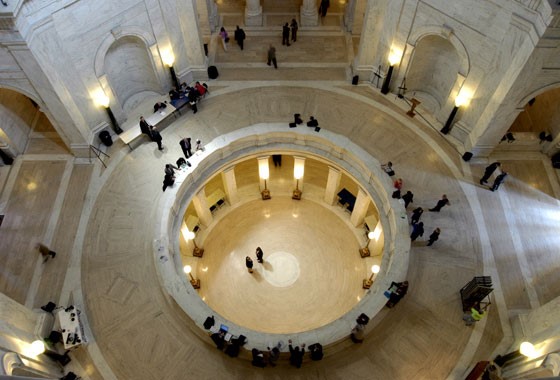
The Well is where conversations happen at the Capitol — where legislators, lobbyists, and staff compare notes, test the mood, and figure out what matters. This briefing is built the same way: a fast, disciplined read on what is moving in West Virginia government before the day begins.
Rotunda Roundup
West Virginia’s policy picture is moving from interim-session discussion toward implementation. Data-center growth is colliding with water-infrastructure and utility questions, lawmakers are beginning to outline 2027 priorities, and a new federal appeals-court decision involving Kalshi adds another important legal development to the national fight over prediction-market sports contracts. At the agency level, water-system consolidation, foster-care support and forensic capacity are producing concrete actions rather than another round of broad policy debate.
What Matters Today
Federal appeals court hands tribes a significant ruling in Kalshi sports-contract case.
The 9th U.S. Circuit Court of Appeals reversed in part the denial of a preliminary injunction sought by two tribes against Kalshi and other defendants. The panel held the tribes were likely to succeed on claims that sports event contracts entered from tribal lands constitute Class III gaming under the Indian Gaming Regulatory Act, while sending the case back to the district court to consider the remaining preliminary-injunction factors. The court separately upheld dismissal of the tribes’ Lanham Act claim concerning Kalshi’s nationwide sports-betting advertising.
Why it Matters: The published opinion adds new federal appellate authority to the unresolved legal dispute over how federally regulated prediction-market sports contracts interact with gambling laws, although the decision arises from tribal gaming law and does not itself resolve West Virginia’s regulatory treatment.
What to Watch: The district court’s handling of the remaining injunction factors, any rehearing request and how the ruling is used in other pending prediction-market litigation.
Source: U.S. Court of Appeals for the Ninth Circuit
Fitch upgrades West Virginia lottery-backed bonds to AA-
Fitch Ratings upgraded West Virginia’s lottery and excess lottery revenue bonds from A+ to AA-, with a stable outlook. The upgrade covers lottery revenue bonds issued by the Higher Education Policy Commission and excess lottery revenue bonds issued by the West Virginia Economic Development Authority, Water Development Authority and School Building Authority.
Fitch cited the financial resilience of the bond structures and strong debt-service coverage, concluding that the revenue streams could withstand substantial declines while continuing to meet debt obligations. The bonds are supported by statutory allocations from state lottery and excess lottery profits, and Fitch noted that lottery revenue growth has strengthened in recent years, in part because of increased online gaming activity. West Virginia’s broader issuer default rating remains AA with a stable outlook, meaning the announcement is an upgrade of these specific lottery-backed obligations rather than the state’s overall credit rating.
Why It Matters: Higher ratings on these revenue bonds can improve borrowing conditions for agencies financing education, economic-development, water and school-building projects and indicate greater confidence in the lottery revenue streams pledged for debt repayment.
What to Watch: Future bond issuances and borrowing costs, lottery and online-gaming revenue trends, and whether continued fiscal performance leads to additional rating actions.
Source: WV MetroNews
Data-center policy is becoming a water-infrastructure debate as HB 2014 implementation approaches its next deadline.
State Office of Energy Director Nicholas Preservati told lawmakers that data-center development could provide revenue to help improve water quality and infrastructure, particularly in the southern coalfields. His comments came as lawmakers continued examining water concerns surrounding development and as the Public Service Commission’s proposed rules implementing HB 2014 remain open for public participation.
Why it Matters: Water supply, water quality and infrastructure financing are emerging as additional pressure points in a data-center debate that has already centered on electricity demand, taxation and local control.
What to Watch: Members of the public who want to participate in the PSC’s Sept. 28 hearing on HB 2014 generating-capacity rules must notify the commission by Sept. 18.
Source: West Virginia Watch
Wheeling approves binding agreement limiting Warwood data center below state’s “high-impact” threshold
Wheeling City Council approved a binding memorandum of understanding with Silicon Foundry Energy LLC governing the company’s proposed data center and energy technology campus at the former Centre Foundry site in Warwood. Under the agreement, Silicon Foundry will keep the facility below 90 megawatts, the threshold at which West Virginia law classifies a project as a “high-impact data center.” Remaining below that threshold keeps the project under greater local zoning and taxing authority rather than the state-centered framework established for high-impact projects.
The agreement also protects Wheeling’s ability to establish or extend a tax increment financing district around the property. Silicon Foundry would be responsible for lost city tax revenue if a future expansion pushed the project beyond the 90-megawatt threshold and affected the TIF district. The council acted after months of public opposition centered on noise, water use, electricity costs and the scale of the project; some residents continue to argue the MOU does not go far enough.
Why It Matters: The agreement illustrates how municipalities may attempt to preserve local leverage over data-center projects that remain below the threshold established under HB 2014 while still using traditional economic-development tools such as TIF financing.
What to Watch: Silicon Foundry’s permitting and power plans, creation or expansion of the Warwood TIF district, continued community opposition and whether other municipalities consider similar agreements for sub-90-megawatt projects.
Source: WV MetroNews
West Virginia American Water will acquire three troubled Fayette County utilities in a $13 million transaction.
Armstrong Public Service District, Kanawha Falls Public Service District and Page-Kincaid Public Service District are set to be sold to West Virginia American Water following years of complaints and PSC proceedings. The transaction becomes final after the Fayette County Commission dissolves the districts; customer rates will rise toward West Virginia American Water levels over three years, and the company is to begin planning immediately to address longstanding sewage leakage at Cannelton Hollow.
Why it Matters: The case is a major example of the state’s continuing reliance on larger regulated utilities to absorb financially or operationally distressed local systems — with direct rate consequences for customers.
What to Watch: Fayette County’s dissolution of the three districts, the three-year rate transition and the company’s remediation plan for Cannelton Hollow.
Source: West Virginia Public Broadcasting
West Virginia energy chief says federal nuclear initiative offers state a range of development options
West Virginia Office of Energy Director Nicholas Preservati is characterizing the federal Nuclear Lifecycle Innovation Campus initiative as offering a broad menu of potential opportunities rather than requiring one predetermined type of nuclear project. West Virginia recently became the sixth state to sign a memorandum of understanding with the U.S. Department of Energy to explore hosting one of the campuses, joining Idaho, Louisiana, Oklahoma, Tennessee and Utah. The MOU advances discussions but does not guarantee that a campus will be located in West Virginia.
DOE’s model allows campuses to combine different portions of the nuclear fuel cycle, including fuel fabrication, enrichment, reprocessing of used nuclear fuel and waste disposition. Federal planning documents and earlier MetroNews reporting also contemplate advanced nuclear generation, manufacturing and co-located energy-intensive operations such as data centers. In other words, West Virginia’s eventual proposal could involve some combination of nuclear generation, fuel-cycle operations and industrial development rather than every element envisioned by the federal program.
The initiative is moving quickly at the federal level. Assistant Secretary for Nuclear Energy Theodore Garrish told a U.S. House Energy and Commerce subcommittee this week that a more formalized host-agreement structure is expected by the end of September, followed by additional contractual details later this year.
Why It Matters: The next stage should begin clarifying exactly what West Virginia is prepared to host — particularly on advanced reactors, fuel processing and spent-fuel management — and what state investment, incentives, infrastructure and community commitments would accompany a proposal.
What to Watch: The state’s preferred mix of nuclear activities, potential West Virginia locations, private-sector partners, treatment of spent nuclear fuel and waste, community-engagement requirements and DOE’s next round of host agreements.
Source: WV MetroNews
Senate Republicans are beginning to put shape around their 2027 legislative agenda.
Sen. Ben Queen, R-Harrison, said workforce participation is expected to be a major focus as Senate Republicans develop their public agenda. He also identified work on a public education package, incentives for local small-business investment, policies intended to encourage existing West Virginia companies to expand and additional energy-generation policy.
Why it Matters: September’s interim meetings are beginning to produce identifiable legislative themes, giving businesses, agencies and advocates an earlier view of issues that could drive the 2027 regular session.
What to Watch: Whether those themes become formal leadership priorities and what specific proposals emerge on workforce benefit cliffs, education, business incentives and generation capacity.
Source: WV News
A proposed Huntington charter school moves into public review while the broader charter-school law remains before the state Supreme Court.
The West Virginia Professional Charter School Board will hold a Sept. 25 public forum at Marshall University on the WISH Academy application. The proposed school would open in August 2027 with pre-K through third grade and eventually expand through fifth grade; if approved, it would become West Virginia’s seventh brick-and-mortar public charter school.
Why it Matters: The application advances as the Supreme Court of Appeals considers a separate constitutional challenge alleging charter schools cannot be created without voter approval.
What to Watch: Public testimony Sept. 25, the Charter School Board’s subsequent application review and the pending Supreme Court litigation.
Source: West Virginia Public Broadcasting
DoHS has launched a statewide online hub for foster and kinship families.
The Bureau for Social Services launched the WV Kinship Hub, allowing foster and kinship caregivers to identify needs and locate services without providing identifying information. The tool is intended to simplify access to support that families otherwise may have to navigate across multiple programs and systems.
Why it Matters: The rollout is a concrete child-welfare implementation step as state officials continue confronting foster placements, caregiver recruitment and the costs and complexity of serving children in state custody.
What to Watch: Adoption of the tool by families and whether DoHS uses participation and service-demand information to drive additional caregiver-support changes.
Source: West Virginia Public Broadcasting
West Virginia State Police will receive more than $582,000 to expand DNA-testing capacity.
Gov. Patrick Morrisey announced $582,174 in federal funding through the DNA Capacity Enhancement for Backlog Reduction Formula Grant Program. The funding is intended to increase DNA samples entered into the FBI’s CODIS system, shorten forensic turnaround times and prevent new evidence backlogs.
Why it Matters: Faster processing affects criminal investigations, cold cases and the ability of State Police laboratories to prevent the kind of evidence backlog West Virginia has previously worked to clear.
What to Watch: How State Police deploy the grant and whether the funding produces measurable reductions in forensic turnaround times.
Source: West Virginia Public Broadcasting
What to Watch
- PSC data-center rules: Sept. 18 is the deadline to notify the Public Service Commission for participation in the Sept. 28 public hearing on HB 2014 electric-generating-capacity rules.
- State Supreme Court: The court’s Sept. 22 docket includes Pushkin, Willingham and the West Virginia Democratic Party v. Morrisey and Hanshaw and the State Board of Education/Michele Blatt case against Secretary of State Kris Warner.
- Prediction markets: Watch the next proceedings in Blue Lake Rancheria v. Kalshi following the 9th Circuit’s remand and for the opinion’s use in litigation outside the circuit.
- 2027 session preparation: Workforce participation, education, business expansion and electric generation are beginning to emerge as Senate Republican policy themes, but the specific legislative vehicles remain to be developed.
- Election administration: County clerks begin mailing absentee ballots Sept. 18, the next major statewide milestone in the 2026 general-election calendar.
Dates Ahead
- Sept. 18: County clerks begin mailing absentee ballots for the general election.
- Sept. 18: Deadline to notify the PSC of intent to participate in the Sept. 28 HB 2014 public hearing.
- Sept. 22: West Virginia Supreme Court docket includes the Pushkin/Morrisey-Hanshaw case and the Board of Education/Blatt case involving Secretary of State Kris Warner.
- Sept. 23: Supreme Court hears SWN Production Co. and Equinor USA Onshore Properties v. Cottrell and Jamestown Resources.
- Sept. 25: Public forum on the proposed WISH Academy charter school, 4-5 p.m., Marshall University’s Corbly Hall.
- Sept. 28: PSC public hearing at 9:30 a.m. on proposed HB 2014 electric-generating-capacity rules.
- Sept. 28: WVDEP deadline for comments on draft Upper Elk River tributary and Eastern Panhandle stream TMDLs.
- Oct. 13: West Virginia voter-registration deadline for the general election.
- Oct. 21-31: Early voting in person.
- Nov. 3: General Election Day.
|