| Opening Note
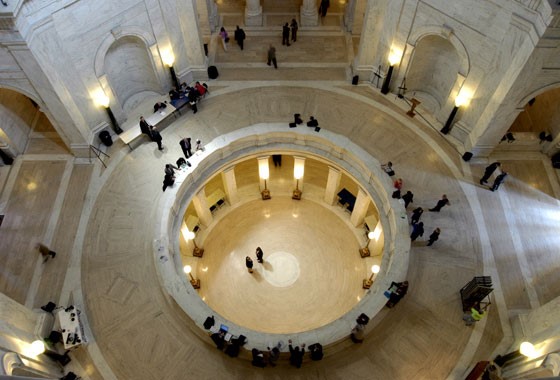
The Well is where conversations happen at the Capitol — where legislators, lobbyists, and staff compare notes, test the mood, and figure out what matters. This briefing is built the same way: a fast, disciplined read on what is moving in West Virginia government before the day begins.
Rotunda Roundup
West Virginia closed its September legislative interims with a stronger-than-expected fiscal picture but a widening list of implementation questions. Revenue remains ahead of forecast even as natural gas markets soften; lawmakers are pressing harder on coal-plant longevity, child-welfare placements, corrections staffing and transportation accountability; and a major federal college-sports bill backed by both West Virginia senators is moving on the Senate floor. The common thread is shifting from announcing policy to proving that government systems — health care, foster care, infrastructure, public safety and energy — can execute.
What Matters Today
West Virginia revenues are running ahead of estimates, but officials are watching softer energy markets.
Revenue officials told the Joint Standing Committee on Finance that August general revenue collections finished $34.8 million above estimate and $52.5 million above last year. Through July and August, collections are $46.1 million above estimate and $53 million ahead of the same period last year. Officials described consumer activity as healthy but pointed to weaker natural gas prices as a developing risk to severance collections and the broader fiscal outlook.
Why it Matters: The early surplus gives policymakers room heading toward the 2027 session, but continued tax-cut or spending decisions will depend heavily on whether the energy side of the revenue base holds up.
What to Watch: September collections, natural gas prices and whether legislative leaders begin translating the early-year performance into specific tax or budget proposals.
Source: WV MetroNews
West Virginia expects another roughly $199 million in federal rural-health funding, although the next allocation is not yet guaranteed.
Health Secretary Dr. Arvin Singh told lawmakers he expects West Virginia’s second-year allocation under the five-year Rural Health Transformation Program to remain roughly level with the $199 million awarded for year one, while emphasizing that this is his expectation rather than a federal commitment. The state has begun moving money through initiatives involving health-worker recruitment, hospital systems and other rural-care projects, and CMS is expected to receive West Virginia’s first quarterly implementation report at the end of November.
Why it Matters: Rural-health transformation is becoming one of the largest new federal funding streams touching West Virginia health policy, with major implications for hospitals, providers, workforce programs and vendors.
What to Watch: CMS’ year-two allocation decision in November and the state’s ability to demonstrate measurable results from the first round of grants.
Source: West Virginia Public Broadcasting
West Virginia is looking for ways to keep its aging coal plants operating longer as the EPA rolls back federal carbon rules.
The Legislature’s Joint Committee on Energy and Public Works heard from the Office of Energy, Public Service Commission, FirstEnergy and Appalachian Power on investments and technology intended to extend the life and efficiency of the state’s coal fleet. FirstEnergy reported roughly $500 million in investment over five years at Fort Martin and Harrison, while Appalachian Power has secured more than $87 million in federal grants and $116 million in low-interest loans for modernization projects. The discussion came as the EPA finalized a partial repeal of its 2024 greenhouse-gas standards for power plants and proposed rescinding the remaining federal greenhouse-gas standards for the sector.
Why it Matters: Federal deregulation and state-backed plant modernization are converging around the same question — how long West Virginia’s coal generating fleet can remain economically and operationally viable inside PJM.
What to Watch: PSC proceedings involving plant investments, West Virginia’s participation in efforts to change PJM governance, and the federal comment process on EPA’s remaining proposed repeal.
Sources: West Virginia Legislature | U.S. EPA
Foster-care numbers are falling, but West Virginia is still spending more than $60 million a year to place hundreds of children outside the state.
West Virginia has 5,719 children in foster care, down from more than 7,000 in 2020, but 390 children were in out-of-state facilities as of June. State officials told lawmakers West Virginia lacks sufficient residential and specialized behavioral-health capacity, particularly for older children with complex needs; the state has about 450 in-state residential beds, while officials said additional psychiatric residential treatment options are under review.
Why it Matters: The overall caseload is improving, but the expensive out-of-state placement problem remains largely unresolved and is likely to return as a budget and provider-capacity issue.
What to Watch: Whether the Department of Human Services presents concrete new in-state treatment projects before the 2027 session and whether lawmakers revisit funding aimed specifically at returning children to West Virginia.
Source: West Virginia Watch
Local governments are directing large shares of opioid-settlement money toward law enforcement, jail bills and EMS.
West Virginia local governments reported spending about $16.76 million in opioid-settlement funds during fiscal 2025. About 23.8% went to law enforcement, 22.6% to jail bills and 21% to EMS, while treatment and recovery accounted for about 17.6%. Jail-bill spending rose to roughly $3.79 million, up more than sixfold from the prior reporting period; the underlying expenditure data are self-reported by local governments.
Why it Matters: The numbers provide a clearer picture of how settlement dollars are actually being deployed and could sharpen future debates over allowable uses, transparency and whether enough money is reaching treatment and recovery services.
What to Watch: Legislative or attorney general scrutiny of local spending practices and future West Virginia First Foundation reporting.
Source: West Virginia Watch
Corrections and State Police recruitment is improving, but retention remains the next workforce problem.
Division of Corrections and Rehabilitation Commissioner David Kelly told lawmakers the agency’s overall vacancy rate is about 15%, including 13% among line officers, after DCR hired 777 correctional officers during fiscal 2026. State Police reported 571 troopers and a goal of roughly 630, while local sheriffs described large pay disparities between jurisdictions that contribute to officers moving from one agency to another.
Why it Matters: After several years in which vacancies drove emergency staffing measures and pay changes, the policy problem is moving from filling positions to keeping trained officers.
What to Watch: DCR’s forthcoming retention data and whether public-safety agencies seek additional compensation or workforce changes during the 2027 session.
Source: WV News
Transportation oversight is moving toward project-by-project performance tracking.
Lawmakers pressed the Department of Transportation for greater visibility into the state’s largest construction projects, including a proposed recurring “Top 25 Projects” dashboard showing original and current cost, completion percentage, schedule changes, change orders and principal risks. Transportation Secretary Stephen Rumbaugh said the department can provide additional information and acknowledged that its existing public project dashboard needs improvement, though he gave no completion date for the changes.
Why it Matters: A standardized dashboard would give legislators and stakeholders a more consistent way to track overruns, delays and performance instead of relying on periodic agency snapshots.
What to Watch: How much of the Legislature’s proposed reporting framework DOT adopts and whether the dashboard becomes a regular oversight tool during interims.
Source: WSAZ
West Virginia voters will decide in November whether to place a citizenship requirement for voting directly into the state Constitution.
Amendment 1 will ask voters whether the state Constitution should specify that only U.S. citizens may vote in West Virginia elections. Existing West Virginia law already prohibits noncitizens from voting; the proposed amendment would constitutionalize the restriction rather than create the underlying prohibition for the first time.
Why it Matters: The ballot measure elevates an existing statutory rule into a constitutional question, making it part of the November statewide election conversation.
What to Watch: Public education and advocacy around the amendment as voter registration closes Oct. 13 and early voting begins Oct. 21.
Source: West Virginia Watch
Both West Virginia senators helped advance a federal bill that could reshape college athletics.
The U.S. Senate voted 74-24 Tuesday to invoke cloture on the motion to proceed to the Protect College Sports Act, with Sens. Shelley Moore Capito and Jim Justice both voting yes. The legislation would establish federal rules covering name, image and likeness compensation, transfers, eligibility and other aspects of college athletics; Capito is a co-sponsor and has highlighted provisions aimed at protecting women’s and Olympic sports. Senate consideration continues Wednesday.
Why it Matters: A national framework would directly affect WVU, Marshall and other West Virginia institutions operating under the rapidly changing economics and legal structure of college athletics.
What to Watch: The Senate’s next procedural votes, amendments and whether the measure advances toward final passage.
Sources: U.S. Senate Roll Call 235 | Sen. Shelley Moore Capito
Human Services has moved CPS and APS background checks onto a new digital platform.
The Department of Human Services launched WV VeriCheck for Child Protective Services and Adult Protective Services background checks, replacing processes that relied heavily on paper and manual handling. The checks are required for prospective foster, kinship and adoptive parents, household members and certain employees and volunteers working with children or vulnerable adults.
Why it Matters: Faster screening has direct implications for foster-care placements, provider hiring and other parts of a child-welfare system already under pressure to expand capacity.
What to Watch: Processing-time improvements, provider adoption and whether the department can document operational savings and reduced placement delays.
Source: West Virginia Department of Human Services
What to Watch
- Supreme Court political cases: On Sept. 22, the state Supreme Court is scheduled to hear the challenge involving the appointment to the Berkeley County House seat and a separate case involving the State Board of Education’s rulemaking authority.
- EPA comment process: EPA’s proposal to repeal the remaining greenhouse-gas standards for fossil-fuel power plants is headed toward a public hearing and comment period following Federal Register publication.
- Rural-health accountability: CMS expects West Virginia’s first quarterly Rural Health Transformation Program report at the end of November, putting early grant execution and measurable outcomes under closer scrutiny.
- DEP water-quality plans: Comments on draft TMDLs covering Upper Elk River tributaries and Eastern Panhandle streams are due Sept. 28 before DEP sends final plans to EPA.
- Transportation accountability: DOT has acknowledged shortcomings in its public project dashboard; the next question is whether lawmakers get the recurring cost, schedule and risk information they requested.
Dates Ahead
- Sept. 22: West Virginia Supreme Court arguments in Pushkin, Willingham and West Virginia Democratic Party v. Morrisey and Hanshaw and the State Board of Education case involving Secretary of State Kris Warner.
- Sept. 23: State Supreme Court argument in SWN Production Co. and Equinor v. Cottrell and Jamestown Resources, a closely watched energy/mineral case.
- Sept. 28: Deadline for public comment on DEP’s draft Upper Elk River and Eastern Panhandle TMDLs.
- Oct. 13: West Virginia voter-registration deadline for the general election.
- Oct. 21-31: Early voting in person.
- Nov. 3: General Election Day.
|