| Opening Note
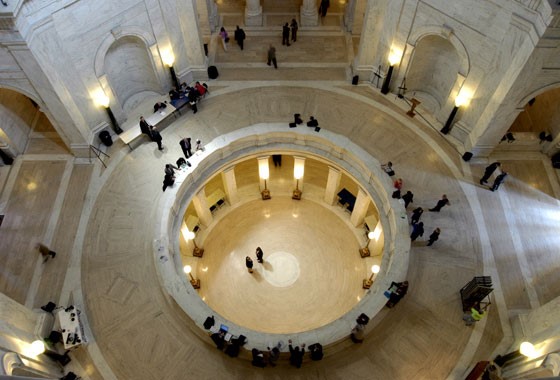
The Well is where conversations happen at the Capitol — where legislators, lobbyists, and staff compare notes, test the mood, and figure out what matters. This briefing is built the same way: a fast, disciplined read on what is moving in West Virginia government before the day begins.
Rotunda Roundup
West Virginia heads into the weekend with several policy fights moving from positioning to substance. Public Service Commission staff has now recommended rejection of NextEra’s MARL transmission project, the state Supreme Court heard a mineral-rights case capable of affecting century-old titles and royalty interests, and lawmakers have begun filling next week’s interim calendar with health, human services, alcohol-regulatory and agency-oversight issues. At the same time, Gov. Patrick Morrisey announced a $100 million-plus rural broadband build, while President Donald Trump signed U.S. Sen. Jim Justice’s legislation clearing the way for the national Medal of Honor monument named for Hershel “Woody” Williams.
What Matters Today
Newly posted interim agendas put psilocybin, health policy, CPS placements, Medicaid rates and Revenue Department oversight before lawmakers next week.
The Legislature has begun posting substantive agendas for its Sept. 13-15 interim meetings. Sunday’s Joint Standing Committee on Health will discuss regulating psilocybin, implementation of the Make West Virginia Healthy Act and counseling licensure. Monday’s Government Organization Committee has Department of Homeland Security Secretary Michael Baylous, an Alcohol Beverage Control Administration update on HB 5437 and Home Rule on its agenda, while the health and human resources oversight commission will take up CPS placements, Certified Community Behavioral Health Clinics, IDD and dental Medicaid rates, the IDD waitlist and implementation of SB 231.
Why it Matters: Last week’s generic interim calendar now has actual policy substance, providing the first clear look at issues lawmakers are developing ahead of the 2027 regular session.
What to Watch: Agendas remain unposted for several major committees, including Finance, Judiciary and Energy and Public Works, leaving room for additional high-value issues to emerge before lawmakers convene.
Source: West Virginia Legislature — Interim Schedule and Agendas
PSC staff is now recommending that regulators reject NextEra’s MARL transmission project.
Direct testimony submitted by Public Service Commission staff recommends denial of NextEra Energy Transmission MidAtlantic’s application for the MidAtlantic Resiliency Link, a significant escalation from staff’s earlier requests to pause or potentially dismiss the proceeding. The commission last week refused to extend the case and kept its existing schedule intact: rebuttal testimony is due Oct. 7, the evidentiary hearing begins Oct. 26 and a commission decision is due by March 6, 2027. MARL would include about 58.9 miles of 500-kilovolt transmission line through Monongalia, Preston, Mineral and Hampshire counties.
Why it Matters: PSC staff’s recommendation does not decide the case, but it materially increases the regulatory risk surrounding one of West Virginia’s most consequential pending transmission proposals.
What to Watch: NextEra’s Oct. 7 rebuttal will be the developer’s first formal opportunity to answer the staff and intervenor testimony now in the record.
Source: WV News
Morrisey announced a $100 million-plus broadband expansion aimed at thousands of rural West Virginia locations.
Armstrong plans to install more than 500 miles of fiber, bringing new broadband service to more than 5,000 previously unserved locations and supporting connectivity for about 10,000 rural homes and small businesses. The investment combines public and private funding through the federal Broadband Equity, Access, and Deployment program, West Virginia’s Line Extension Advancement and Development program and the Federal Communications Commission’s Enhanced Alternative Connect America Cost Model. Morrisey announced the expansion Thursday in Hamlin alongside Armstrong President Jeff Ross, FCC Commissioner Olivia Trusty and state and federal partners.
Why it Matters: The announcement moves a substantial piece of West Virginia’s broadband strategy from grantmaking and planning into physical deployment, particularly in areas where terrain and low population density have limited private investment.
What to Watch: Construction milestones, the specific communities reached and how quickly the announced projects convert funded locations into active customer connections.
Source: WTAP
The state Supreme Court heard a mineral-rights case that could determine whether “one-sixteenth” in a 1902 deed can legally mean one-half.
The Supreme Court of Appeals heard arguments Thursday in Severin POA Group LLC v. Earl J. Nicholson and Joyce A. Nicholson, a Doddridge County dispute over a 117.55-acre tract. The Intermediate Court of Appeals previously concluded that the deed reserved a literal one-sixteenth mineral interest; the opposing side argues that early oil-and-gas leasing practices and the historical “estate misconception” theory support treating the reservation as one-half. Several justices pressed counsel on the consequences of looking beyond otherwise clear deed language.
Why it Matters: A ruling could establish statewide precedent for interpreting old fractional mineral reservations, with consequences for title certainty and royalty ownership in producing oil-and-gas counties.
What to Watch: Whether the court adopts a strict plain-language approach or allows historical industry practices and outside evidence to influence interpretation of old mineral deeds.
Source: WV News
West Virginia Chamber releases 2026 CourtWatch review of state Supreme Court decisions
The West Virginia Chamber of Commerce has released its 2026 CourtWatch, its annual examination of significant West Virginia Supreme Court of Appeals decisions and the potential consequences those rulings have for businesses, employers and the state’s legal environment. The accompanying presentation at the Chamber’s 90th Annual Meeting and Business Summit reviewed dozens of major decisions from the state’s highest court and provided legal analysis of their practical effects.
The review was presented by attorneys Susan Deniker of Steptoe & Johnson, Joseph “Jay” Ford of Spilman Thomas & Battle, Tom Hurney Jr. of Jackson Kelly, Jill Cranston Rice of Dinsmore & Shohl and Marc Williams of Nelson Mullins, with West Virginia Chamber legal counsel Kaitlyn Pytlak-Morra moderating.
Why it Matters: CourtWatch provides a useful measure of how West Virginia’s organized business community views the direction of the state judiciary. Decisions identified as creating uncertainty or changing liability standards can also become candidates for legislative action when lawmakers return to Charleston.
What to Watch: Which recent Supreme Court decisions the Chamber identifies as most consequential for employers and whether business organizations seek statutory changes during the 2027 legislative session in response.
Source: WV News — West Virginia Chamber releases 2026 CourtWatch report
President Trump signed Justice’s bill authorizing the national Medal of Honor monument on the National Mall.
Trump signed the Hershel “Woody” Williams National Medal of Honor Monument Location Act during a Thursday visit to the National Medal of Honor Museum in Arlington, Texas. The legislation, sponsored by U.S. Sen. Jim Justice, authorizes the National Medal of Honor Museum Foundation to establish the commemorative work within the National Mall Reserve; the monument will honor all Medal of Honor recipients and carry the name of Williams, the West Virginian who was the final surviving World War II Medal of Honor recipient.
Why it Matters: The signature completes a bipartisan federal legislative effort with a direct West Virginia connection and clears a statutory location obstacle for the planned national monument.
What to Watch: The foundation’s next design, approval and construction steps for the Washington monument.
Source: WV News
Federal nuclear-campus plan could bring spent-fuel management, reactors and nuclear-powered data centers to West Virginia
New details about the federal Nuclear Lifecycle Innovation Campuses program show West Virginia is competing for a project that could encompass far more than nuclear power generation. The U.S. Department of Energy envisions integrated campuses involving nuclear-fuel enrichment, advanced reactors, reprocessing or recycling of used nuclear fuel, long-term management of radioactive waste and energy-intensive users such as artificial intelligence data centers. DOE anticipates private investment providing much of the capital, but host states also would be expected to contribute resources.
Gov. Patrick Morrisey announced that West Virginia signed a memorandum of understanding with DOE to become the sixth state under final consideration after initially being excluded from the five-state finalist group. Twenty-six states submitted 28 applications. The West Virginia agreement has not been publicly released, leaving unanswered what sites, private partners or specific commitments the state proposed. DOE expects to select host locations by the end of 2026 and envisions initial facilities beginning development on an accelerated timetable.
Senate Energy Chairman Chris Rose supports exploring the opportunity but said an eventual agreement needs to demonstrate economic benefits while addressing financing, safety, community concerns and responsibility for nuclear materials, with protections for taxpayers and electric customers. Del. Kayla Young, D-Kanawha, similarly called for greater transparency about what West Virginia has proposed.
Why it Matters: The details materially broaden the implications of West Virginia’s nuclear-campus bid. It potentially connects three major policy debates already developing in the state — nuclear energy, data-center expansion and management of radioactive waste — while raising questions about state financial commitments and community siting.
What to Watch: Release of West Virginia’s memorandum with DOE; potential locations and private-sector partners; the level of state financial participation; and whether spent-fuel storage or reprocessing becomes a significant legislative or political issue.
Source: WV MetroNews — Federal plan for nuclear hubs envisions handling spent fuel and powering data centers
A new report puts West Virginia hospital price-transparency compliance at 19% under the reviewing organization’s methodology.
WV News reported Thursday that 19% of West Virginia hospitals reviewed by Patient Rights Advocate fully complied with federal hospital price-transparency requirements under the group’s standards. Nationally, the organization said 49% of 2,000 hospitals it reviewed complied, up from 21% in its previous report, while only 18% posted dollar-and-cents prices for at least half of the services in their pricing files. Patient Rights Advocate credited recent CMS technical guidance and stepped-up enforcement in part for the national improvement; its findings are an outside assessment rather than an official CMS determination of individual hospital compliance.
Why it Matters: Hospital price transparency remains an active federal compliance issue, and the West Virginia finding creates additional scrutiny for health systems as CMS increases enforcement.
What to Watch: Any West Virginia-specific enforcement actions, hospital responses to the report and whether CMS assessments align with the advocacy group’s methodology.
Source: WV News
Justice Department will appeal ruling blocking access to unredacted West Virginia voter data
The U.S. Department of Justice will appeal a federal judge’s dismissal of its lawsuit seeking West Virginia’s unredacted voter registration database. DOJ filed notice with the 4th U.S. Circuit Court of Appeals, although its substantive appellate arguments have not yet been filed. U.S. District Judge Thomas Johnston dismissed the case in July, finding that the federal government failed to establish an adequate factual basis or valid purpose for demanding the records. DOJ sought information including voters’ names, residential addresses, dates of birth, driver’s license numbers and partial Social Security numbers under the Civil Rights Act of 1960. Secretary of State Kris Warner opposed the demand, arguing that the database was protected and the federal request legally deficient.
Why it Matters: The appeal keeps alive a significant federal-state dispute over election administration, voter privacy and the reach of federal authority to inspect state voter records. MetroNews reports that DOJ has lost numerous similar voter-roll cases around the country, including an appellate loss involving Michigan.
What to Watch: The legal theory DOJ advances before the 4th Circuit and whether the appellate court concludes federal election law gives the department broader access to sensitive state voter-registration information.
Source: WV MetroNews — U.S. Justice Department says it will appeal West Virginia ruling over unredacted voter data
New data shows sharp increase in West Virginians choosing no-party ballots after Republicans closed their primary
New Secretary of State data provides the first detailed look at voter behavior under West Virginia Republicans’ return to a closed primary. More than 21,000 voters chose a no-party ballot in the May primary, a 74% increase from the comparable 2022 midterm election, while unaffiliated voter registration increased 13%. At the same time, the number of Republican ballots cast declined 22% from 2022 even as Republican registration continued to increase.
West Virginia had approximately 1.2 million registered voters eligible for the primary, with turnout of 21.03%. Of 252,008 ballots cast, 126,365 were Republican and 104,028 were Democratic. Democratic registration declined 17% compared with 2022, although Democratic primary ballot participation increased slightly.
The election was the first in decades in which unaffiliated voters could not participate in the Republican primary and also the first conducted under West Virginia’s stricter photo-identification law. The Secretary of State reported that the largest category of polling-place problems involved missing, incomplete or unclear signage, while complaints involving closed-primary requirements were the second-largest category.
The article also notes private speculation among some Republicans that anger over the closed-primary rules may have influenced the nonpartisan Supreme Court elections, where Bill Flanigan and H.L. “Kirk” Kirkpatrick defeated candidates backed by Morrisey. That connection has not been established by the election data and remains political interpretation rather than a demonstrated finding.
Why it Matters: The numbers provide the first substantial evidence of how closing the Republican primary affected voter behavior. The combination of increasing unaffiliated registration, sharply higher use of no-party ballots and reduced Republican primary participation gives party leaders and lawmakers actual data to evaluate the consequences of the change.
What to Watch: Whether Republican leaders reconsider the closed-primary policy before the next election cycle; continued growth among unaffiliated voters; and how candidates respond to a growing bloc of voters who can participate in nonpartisan races but not the Republican primary.
Source: West Virginia Watch — Data shows big jump in WV voters choosing no-party ballot in closed Republican May primary
What to Watch
- MARL enters its rebuttal phase. PSC staff’s recommendation to reject the project changes the substance of the fight. NextEra must now build its response while the commission continues toward the Oct. 26 evidentiary hearing.
- More interim agendas are still coming. Finance, Judiciary, Energy and Public Works, Flooding, Technology and Infrastructure and several other committees still lacked posted agendas Thursday evening.
- Health policy gets an unusually dense interim slate. Psilocybin regulation comes before the Joint Health Committee Sunday, followed Monday by CPS placement oversight, behavioral health clinics, Medicaid reimbursement and the IDD waitlist.
- Revenue and alcohol regulation return Monday. Government Organization has an ABCA/Department of Revenue update on HB 5437 on its posted agenda, along with Home Rule and Department of Homeland Security oversight.
- High water bears watching after Thursday’s storms. Mason County and portions of the Ohio Valley experienced localized flooding and road impacts Thursday; watch for any state emergency-management action or requests for assistance if conditions produce more significant damage.
Dates Ahead
Sunday, Sept. 13, 5-7 p.m. — Joint Standing Committee on Health: psilocybin regulation; Make West Virginia Healthy Act implementation; counseling licensure.
Monday, Sept. 14, 9-11 a.m. — Joint Standing Committee on Government Organization: Department of Homeland Security; ABCA/Department of Revenue update; Home Rule Board.
Monday, Sept. 14, 4-6 p.m. — Legislative Oversight Commission on Health and Human Resources Accountability: CPS placements; Certified Community Behavioral Health Clinics; IDD and dental Medicaid rates; IDD waitlist; SB 231.
Tuesday, Sept. 15 — Finance and Judiciary meet from 9-11 a.m.; Energy and Public Works meets from noon-2 p.m.; Department of Transportation oversight meets from 2-3 p.m. Several agendas remained outstanding Thursday evening.
Oct. 7 — Rebuttal testimony due in PSC Case No. 26-0075-E-CN, the MARL proceeding.
Oct. 26-Nov. 2 — MARL evidentiary hearing before the West Virginia Public Service Commission.
March 6, 2027 — Statutory PSC decision deadline in the MARL case. |