| Opening Note
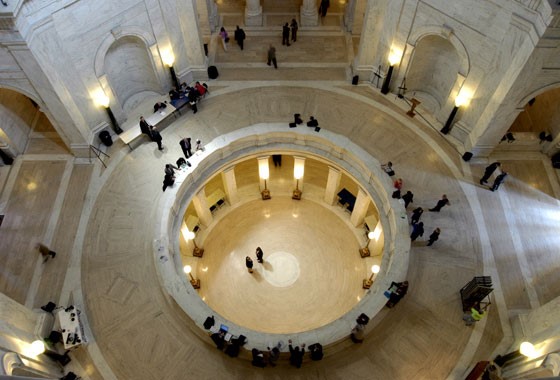
The Well is where conversations happen at the Capitol — where legislators, lobbyists, and staff compare notes, test the mood, and figure out what matters. This briefing is built the same way: a fast, disciplined read on what is moving in West Virginia government before the day begins.
Rotunda Roundup
The long holiday weekend produced more consequential movement in courts and regulatory dockets than in electoral politics. The Public Service Commission refused to slow the MARL transmission case, a new lawsuit directly challenges universal expansion of the Hope Scholarship, GreenPower’s state-backed South Charleston project has moved deeper into court trouble, and the state Supreme Court returns Tuesday to a corrections-liability question with consequences well beyond the two cases before it. At the same time, West Virginia has begun converting its federal rural-health award into actual programs, while a new housing assessment is putting another potential constraint on the state’s economic-development ambitions into the legislative conversation.
What Matters Today
The PSC refused to delay MARL and ordered NextEra to explain whether an existing transmission corridor could accommodate part of the project.
The Public Service Commission on Friday denied requests from its own staff and NextEra Energy Transmission MidAtlantic to alter the procedural schedule for the MidAtlantic Resiliency Link. Staff and intervenor testimony remains due Tuesday, the evidentiary hearing remains scheduled for Oct. 26-Nov. 2, and the commission’s decision is still due March 6, 2027. In a separate order, the PSC directed NextEra to provide, within 10 days, a detailed analysis of whether the existing Gore-Hampshire right of way could be used or widened rather than building a separate corridor, including engineering, environmental, cost, reliability and scheduling considerations.
Why it Matters: The commission rejected the principal effort to buy more time in one of West Virginia’s most consequential transmission proceedings, keeping pressure on NextEra, PSC staff, landowners and intervenors as the state confronts rapidly increasing power demand.
What to Watch: Tuesday’s testimony could sharpen the disputes over routing, ratepayer exposure, project completeness and environmental impacts; NextEra also must answer the commission’s existing-right-of-way questions this month.
Source: West Virginia Public Service Commission | WV MetroNews
West Virginia’s energy strategy is moving from preserving legacy industries toward building enough generation and infrastructure to capture surging power demand.
West Virginia’s political and energy leadership sees a rare alignment between state policy, federal policy and rapidly increasing electricity demand from data centers, artificial intelligence, manufacturing and industrial reshoring. Gov. Patrick Morrisey’s “50 by 50” strategy calls for increasing the state’s electric-generating capacity from roughly 16 gigawatts to 50 gigawatts by 2050, with coal, natural gas, nuclear, hydropower, hydrogen and geothermal resources all potentially contributing.
Industry leaders say the Trump administration’s energy and environmental policies have created a substantially more favorable climate for coal and natural gas development, but they also warn that political alignment alone will not produce investment. Gas and Oil Association of West Virginia President-elect Rebecca McPhail said continued natural gas growth will require additional pipeline capacity, predictable permitting, competitive tax and regulatory policies and new markets. The broader challenge is providing enough regulatory stability for companies to commit billions of dollars to infrastructure with decades-long investment horizons.
Coal producers are confronting a different challenge. West Virginia Coal Association President Chris Hamilton said metallurgical coal accounts for roughly 45% of the state’s coal production and represents an approximately $10 billion industry, but prices have fallen about 40% during the past 18 months. Hamilton is calling for West Virginia to reduce the severance tax on metallurgical coal from 5% to 3%, arguing the state is at a competitive disadvantage against other producing states.
Why it Matters: West Virginia’s energy debate is increasingly about whether the state can build generation, transmission, pipelines and other infrastructure quickly enough to serve enormous prospective industrial loads without exposing existing customers to excessive costs. The policy discussion also is likely to expand beyond traditional environmental debates into tax competitiveness, permitting timelines, infrastructure financing and who ultimately bears the cost of serving new large-load customers.
What to Watch: Implementation of the 50-by-50 strategy; proposals involving pipeline and generation permitting; potential legislation reducing the metallurgical coal severance tax; new gas-fired generation projects; large-load utility tariffs; and whether expected data-center and manufacturing demand develops quickly enough to justify the level of infrastructure investment now being contemplated.
Source: WV News / State Journal
Starwood provides new details on its $12 billion Mason County data-center project, including private infrastructure financing, workforce partnerships and water protections.
Starwood Digital Ventures says its planned $12 billion Project Tamarack data-center campus in Mason County will enter pre-development before the end of 2026, with design and permitting continuing ahead of phased construction. The project, planned for the West Columbia area, already has received West Virginia’s high-impact data-center certification and is expected to support about 300 permanent jobs and approximately 1,000 construction jobs.
The company says it will use existing AEP infrastructure and pay for electrical-system improvements required by the project rather than passing those costs to existing West Virginia customers. Starwood has signed a ratepayer-protection pledge and says it does not intend to seek public financing or a state incentive package for the development.
Starwood also is providing more detail about how it intends to address two of the most persistent concerns surrounding large data centers: water consumption and workforce availability. Project Tamarack will use a closed-loop cooling system intended to minimize water use, and the company has pledged to restore the equivalent of 200% of the water it consumes through conservation and stewardship projects. Workforce partnerships are being developed with Mason County Schools, Mountwest Community and Technical College and Marshall University to establish training pathways for data-center operations and construction jobs. Mason County residents and veterans also are expected to receive early access to employment opportunities.
Why it Matters: The additional details provide an early test of how West Virginia’s new high-impact data-center framework will work in practice. Starwood is attempting to address the political vulnerabilities accompanying major data-center projects — particularly electric-rate impacts, water use and whether promised jobs will reach local residents — before construction begins.
What to Watch: Completion of permitting and final design; the project’s eventual power requirements and utility agreements; enforcement of the ratepayer-protection commitment; details of the workforce-training programs; local tax impacts; and whether Starwood’s projected construction and permanent employment levels materialize as the campus is built out.
Source: WV News / State Journal
Mingo County parents are asking a judge to halt the universal expansion of West Virginia’s Hope Scholarship program.
Eleven parents filed suit Friday against the State Treasurer’s Office, Hope Scholarship Board and State Superintendent Michele Blatt, challenging the program’s expansion to all K-12 students. The plaintiffs contend that expanding the scholarship while leaving the public-school funding formula unchanged violates the state Constitution’s requirement for a “thorough and efficient” system of free schools; they specifically seek to halt further payments to first-time applicants who became eligible through universal expansion. More than 25,000 students are participating this school year, with scholarships worth roughly $5,400 per student.
The challenge comes four years after the state Supreme Court upheld the underlying Hope Scholarship program. The Mingo plaintiffs argue the scale and measurable effects are now substantially different, pointing to declining enrollment, financial stress and the planned closure of Dingess Elementary.
Why it Matters: The case puts the Legislature’s signature school-choice program back before the courts at the same time shrinking enrollment and county financial problems are intensifying pressure to rewrite West Virginia’s school-aid formula.
What to Watch: Whether the court considers preliminary relief before additional scholarship disbursements, how the state answers the constitutional claims and whether the litigation pushes school funding back onto the Legislature’s near-term agenda.
Source: West Virginia Watch
The state Supreme Court will decide whether “deliberate indifference” can stand as an independent state-law claim against West Virginia corrections officials.
The Supreme Court of Appeals is scheduled to hear consolidated Rule 20 arguments at 10 a.m. Tuesday in two wrongful-death cases involving the Division of Corrections and Rehabilitation. The state is seeking writs blocking lower-court rulings that allowed deliberate-indifference claims to proceed, arguing that the concept is a federal constitutional standard rather than a separate West Virginia common-law tort; the plaintiffs argue state precedent permits such claims. Attorney General J.B. McCuskey has filed an amicus brief supporting the corrections division.
The court will follow that argument at 10:40 a.m. with a related corrections case involving qualified immunity.
Why it Matters: A ruling could reshape the state’s exposure in inmate-death and medical-neglect litigation and affect the legal path available in multiple pending cases involving West Virginia correctional facilities.
What to Watch: The justices’ treatment of prior West Virginia precedent, sovereign and qualified-immunity arguments, and whether the court draws a clear distinction between federal constitutional claims and state tort liability.
Source: West Virginia Judiciary — September docket | WV News
GreenPower Motor’s top executives have been ordered into a Kanawha County courtroom after buses subject to a court freeze were allegedly moved out of West Virginia.
Circuit Judge Jennifer Bailey has ordered GreenPower President Brendan Riley and CEO Fraser Atkinson to appear Friday after as many as seven buses covered by a freeze order were allegedly removed from the state. The order was intended to preserve assets against three default judgments obtained by former employees that their attorney says total about $2 million. The attorney said removal of the buses could lead to a referral to the Kanawha County Prosecutor’s Office and that failure to appear could expose company officials to contempt sanctions.
The dispute adds another layer to GreenPower’s deteriorating West Virginia position after the electric-bus manufacturer failed to meet employment expectations associated with its South Charleston operation. MetroNews reports the company received $15 million from West Virginia for bus purchases, $18.5 million through the federal Clean School Bus Program and a $300,000 state Learn and Earn grant.
Why it Matters: A heavily promoted, publicly supported economic-development project is now confronting an asset-preservation dispute, employment judgments and potential contempt proceedings, raising broader questions about incentive oversight and the state’s remaining exposure.
What to Watch: Friday’s court appearance, any contempt or prosecutor referral, the location and disposition of the buses and whether state agencies take additional steps involving GreenPower’s remaining obligations or assets.
Source: WV MetroNews
West Virginia has made its first implementation awards from the nearly $199.5 million federal Rural Health Transformation Program allocation.
Gov. Patrick Morrisey announced nearly $2.4 million Friday for worksite clinics and employer-based health services under the state’s Health to Prosperity initiative. Spotted Owl Healthcare Organization will receive $1.174 million, while CAMC/Vandalia Health and the Cabell Huntington Foundation will each receive $612,000. The Department of Health says these are the first implementation awards under the broader program and that additional awards will follow across seven initiatives.
West Virginia’s first-year federal award totals $199,476,098.72. Health Secretary Arvin Singh has told lawmakers the state is working toward obligating the full amount by Oct. 30.
Why it Matters: The rural-health initiative is moving from announcements and funding opportunities into actual implementation, providing the first concrete look at how the Morrisey administration intends to use one of the state’s largest new federal health investments.
What to Watch: The next rounds of awards, geographic distribution, performance requirements and whether the state can obligate the remaining first-year funding on schedule.
Source: West Virginia Department of Health
EPA and the Army are reopening a portion of the federal Waters of the United States rulemaking, carrying direct permitting implications for West Virginia development and energy projects.
The U.S. Environmental Protection Agency and Department of the Army announced Friday that they will seek additional public comment on alternative regulatory language defining “waters of the United States,” or WOTUS, alongside the agencies’ 2025 proposal. The definition determines the reach of federal Clean Water Act regulatory programs and therefore when federal permits are required; the agencies say the final rule is intended to implement the U.S. Supreme Court’s 2023 Sackett decision.
A 30-day comment period will begin when the supplemental proposal is published in the Federal Register.
Why it Matters: Changes in federal jurisdiction can materially affect permitting exposure for West Virginia energy, manufacturing, data-center, infrastructure, agriculture and land-development projects while shifting greater responsibility to state regulation for waters outside federal jurisdiction.
What to Watch: The regulatory alternatives published in the Federal Register and responses from West Virginia regulators, industry groups, agricultural interests, developers and environmental organizations.
Source: U.S. Environmental Protection Agency
A new housing assessment is turning West Virginia’s economic-development success into a workforce and infrastructure policy question for lawmakers.
An updated Advantage Valley assessment projects a 28,976-unit housing shortfall across the region over the next five years — 10,604 rental units and 18,372 homes for sale. Multifamily occupancy has reached 98.4%, only 621 homes were available for purchase when the assessment was conducted, and more than 1,300 households were on affordable-housing waiting lists. The study comes as roughly 5,400 manufacturing jobs announced since 2022 are projected to generate more than 17,000 direct and indirect jobs.
Sen. Ben Queen has identified housing as part of the state’s broader workforce strategy and raised the possibility of permitting “shot clocks,” while developers are pressing for infrastructure assistance, financing and incentives. Advantage Valley’s housing task force is expected to continue meeting this month and consider potential legislation.
Why it Matters: West Virginia’s ability to convert major industrial investments into sustained population and workforce growth increasingly depends on housing, utilities, child care and permitting — potentially creating another economic-development policy package for the 2027 session.
What to Watch: Whether the September task-force work produces specific legislation involving permitting timelines, infrastructure funding, development incentives or revisions to the Build West Virginia framework.
Source: WV News / State Journal
What to Watch
- Legislative interims are beginning to take shape. Lawmakers return Sept. 13-15, with Health, Economic Development, Technology and Infrastructure, PEIA, Education, Children and Families, Finance, Judiciary, Corrections and Public Safety, and Energy and Public Works among the scheduled committees. Most agendas had not yet been posted as of Monday evening, making the coming agenda releases the first indication of which issues lawmakers intend to elevate heading toward 2027.
- The former Entsorga waste facility is back before Berkeley County regulators. The Berkeley County Solid Waste Authority will hold a 6 p.m. Wednesday hearing on BurCell Martinsburg LLC’s application for site approval to redevelop the shuttered Martinsburg facility as a mixed-waste processing plant. Written comments remain open for 10 days after the hearing.
- Potomac Edison’s next West Virginia transmission case is approaching. FirstEnergy says a West Virginia application is expected later this year for the Gore-Doubs-Goose Creek project, including approximately 15.4 miles through Jefferson County. The project would add 500-kV capacity largely within an existing transmission corridor and forms another piece of the regional grid buildout now converging on West Virginia.
- West Virginia American Water’s next infrastructure-surcharge case now has a schedule. The PSC set a Dec. 10 hearing in Case No. 26-0607-WS-DSIC, with an Oct. 9 intervention deadline and testimony beginning in October. The Consumer Advocate Division has been admitted to the proceeding.
Dates Ahead
- Sept. 8 — MARL: PSC staff and intervenor direct testimony is due in Case No. 26-0075-E-CN.
- Sept. 8 — Supreme Court: Oral arguments begin at 10 a.m. in the consolidated corrections “deliberate indifference” cases, followed at 10:40 a.m. by a related corrections case involving qualified immunity.
- Sept. 9 — Oil and gas pooling: The Oil and Gas Conservation Commission has an Antero Resources hearing at 10 a.m. and an EQT Production hearing at 11:30 a.m. involving requests to establish drilling units and pool unleased interests.
- Sept. 9 — Mountaineer Gas: The statement of issues remaining is due in PSC Case No. 26-0079-G-42T.
- Sept. 9 — Berkeley County: Public hearing at 6 p.m. on BurCell Martinsburg LLC’s proposed redevelopment of the former Entsorga facility.
- Sept. 11 — GreenPower: President Brendan Riley and CEO Fraser Atkinson have been ordered to appear before Kanawha Circuit Judge Jennifer Bailey.
- Sept. 13-15 — Legislative interims: The West Virginia Legislature returns to Charleston for three days of interim committee meetings.
|