| Opening Note
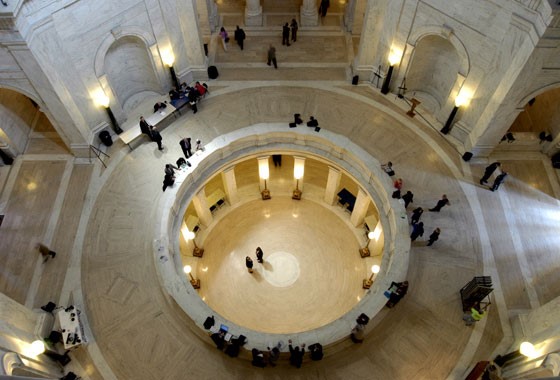
The Well is where conversations happen at the Capitol — where legislators, lobbyists, and staff compare notes, test the mood, and figure out what matters. This briefing is built the same way: a fast, disciplined read on what is moving in West Virginia government before the day begins.
Rotunda Roundup
West Virginia’s operating picture tonight is being shaped less by new legislation than by the courts, commissions and institutions that determine how major policy moves actually take effect. The MARL transmission case could be pushed deep into 2027, the attorney general scored a significant federal win against New York’s climate-superfund law, the Tucker County data-center fight is headed toward another round before the state Supreme Court, and federal mail-voting rules remain frozen. At the same time, lawmakers are beginning to put shape around next year’s Flock camera debate, while federal investment priorities and hospital consolidation are changing the state’s economic-development and health-care landscape.
What Matters Today
NextEra and PSC staff now jointly want a 77-day reset of the MARL transmission case after five route changes.
NextEra Energy Transmission and West Virginia Public Service Commission staff filed a joint motion Monday seeking to postpone the evidentiary hearing from Oct. 26-Nov. 2 to Jan. 11-18 and move the target for a final PSC decision from March 6 to May 22, 2027. The proposal would reopen discovery only on five recent route revisions and extend the intervention deadline to Sept. 30 for three newly affected landowners. The West Virginia Energy Users Group also supports a delay.
Why it Matters: This is a material change from the earlier staff request for a pause or dismissal and establishes a potential new timetable for one of West Virginia’s highest-stakes transmission proceedings.
What to Watch: The PSC must decide whether to approve the joint schedule; the commission could still impose different procedural requirements as it addresses questions raised by the route changes.
Source: WV MetroNews
West Virginia won a major federal ruling against New York’s $75 billion climate-superfund law.
Chief U.S. District Judge Brenda Sannes struck down New York’s Climate Change Superfund Act in litigation led by West Virginia Attorney General JB McCuskey, the Trump administration and energy-industry challengers. The law sought $75 billion from fossil-fuel producers based on activity between 2000 and 2024; the court concluded that it conflicted with federal authority under the Clean Air Act.
Why it Matters: The ruling is a significant legal victory for West Virginia’s attorney general with potential financial consequences for coal, oil and natural gas companies operating in the state and broader implications for state efforts to impose climate-related liability.
What to Watch: Whether New York appeals and how the ruling affects West Virginia’s separate challenge to Vermont’s climate-superfund regime.
Source: WV News
The federal mail-ballot rule remains blocked after a judge rejected the Trump administration’s latest effort to revive it Monday.
U.S. District Judge Indira Talwani declined Monday to overturn the 14-day restraining order blocking a new U.S. Postal Service rule that would require states to make significant changes to mail-ballot procedures, including federal approval of ballot-envelope designs and submission of mail-voter information. Talwani wrote that USPS likely lacked authority to issue the rule and that the regulation was likely unconstitutional; litigation is also underway in the 1st U.S. Circuit Court of Appeals.
Why it Matters: The ruling leaves the nationwide requirements on hold during a critical election-administration window and temporarily removes the immediate implementation burden facing state and county election officials.
What to Watch: A Sept. 3 hearing will consider whether the temporary order should be replaced with a longer preliminary injunction.
Source: News From The States
The Tucker County data-center permit fight is now moving toward the West Virginia Supreme Court rather than ending with last week’s Intermediate Court dismissals.
Residents and advocacy organizations challenging the West Virginia Department of Environmental Protection’s air permit for Fundamental Data’s Ridgeline project say they will ask the Supreme Court of Appeals to settle where their challenges should be heard. The Intermediate Court’s rulings addressed jurisdiction and mootness rather than deciding the merits of the air permit or the project’s use of confidential business information. The proposed facility would use an on-site natural gas microgrid capable of producing at least 750 megawatts.
Why it Matters: The latest move keeps a major West Virginia data-center project in active litigation and could establish the judicial path for future challenges to DEP permitting decisions.
What to Watch: The Supreme Court filing, whether the court accepts jurisdiction and whether challengers seek any interim relief affecting construction or permitting.
Source: West Virginia Watch
The Flock camera debate now has a likely 2027 legislative component.
Following the Monongalia County system’s role in locating an abducted child over the weekend, Del. Tristan Leavitt, R-Kanawha, said Monday he has “very high hopes” lawmakers can pass legislation addressing the technology next year. Leavitt’s concerns center on who can access data once it is held by Flock and whether the information is adequately protected, while Monongalia County Sheriff Todd Forbes defended his department’s use of the cameras as limited to license-plate and vehicle information.
Why it Matters: The conversation is shifting from whether automated license-plate readers work to what statutory limits West Virginia should place on data retention, access, sharing and security.
What to Watch: Draft legislation ahead of the 2027 regular session, particularly provisions governing retention periods, interagency sharing, third-party access and security standards.
Source: WV MetroNews
Charleston’s $20 million LIFT Center is nearing completion without a tenant after its federal mission shifted toward advanced manufacturing and energy.
The 55,000-square-foot facility on Charleston’s East End is scheduled for completion in November, but no employer has committed to occupy it. Originally envisioned under Biden-era coal-community grants around food production and green technology, the project’s scope changed under the Trump administration’s Economic Development Administration to target advanced manufacturing or energy companies. Sen. Shelley Moore Capito toured the facility Monday as local officials continue recruiting prospective tenants.
Why it Matters: The project is an early West Virginia example of how changing federal economic-development priorities can redirect an already-funded project — with the ultimate measure being whether the investment produces permanent private-sector jobs.
What to Watch: A tenant announcement before the November completion date, along with the company’s sector, employment commitment and additional incentives required to land it.
Source: WV MetroNews
Grafton City Hospital officially joined Vandalia Health, ending its run as an independent North Central West Virginia hospital.
Hospital, city and Vandalia officials completed the transition Monday, with the facility becoming Vandalia Health Grafton Hospital effective Sept. 1. Vandalia plans $5 million in infrastructure improvements, while the hospital also has received $1.5 million in federal earmarks for infrastructure work. The integration builds on a management relationship that began with Mon Health in 2019.
Why it Matters: The transaction further consolidates West Virginia’s hospital market while bringing new capital behind a rural facility facing the cost and scale pressures confronting independent hospitals.
What to Watch: The timing and scope of Vandalia’s promised investments, changes in services and staffing, and the longer-term effect of the affiliation on rural access.
Source: WV News
Justice H.L. “Kirk” Kirkpatrick was formally welcomed to the West Virginia Supreme Court as the court prepares to open its fall argument calendar Wednesday.
Kirkpatrick participated in his public investiture at the Capitol on Monday after taking the bench earlier this summer following his May election to the seat formerly held by the late Justice Tim Armstead. He joins another newly elected justice, Bill Flanigan, as the court begins its fall term Wednesday with eight cases on the argument docket.
Why it Matters: The new membership of the state’s highest court now moves from transition to active appellate work, important for businesses, agencies and litigants watching the court’s approach to regulatory, constitutional and civil disputes.
What to Watch: The court’s first opinions and significant arguments with Kirkpatrick and Flanigan participating as elected justices.
Source: WV MetroNews
Sen. Jim Justice’s Woody Williams monument bill cleared the U.S. House and is headed to President Donald Trump.
The House passed the Hershel “Woody” Williams National Medal of Honor Monument Location Act on Monday. The measure, introduced by Justice as his first Senate bill, would establish a monument on the National Mall honoring Medal of Honor recipients and bearing the name of the late Fairmont native and World War II Medal of Honor recipient.
Why it Matters: The House vote gives West Virginia’s congressional delegation a concrete bipartisan legislative win and leaves only presidential action before the monument legislation becomes law.
What to Watch: Trump’s signature and the subsequent federal process for selecting, approving and developing the National Mall site.
Source: WV MetroNews
Kanawha County is pursuing a USDA-backed flood buyout program and has committed $500,000 toward the local match.
The Kanawha County Commission voted to apply for the U.S. Department of Agriculture Natural Resources Conservation Service’s Emergency Watershed Protection Recovery Buyout Program. USDA can cover up to 75% of the cost, with the county approving $500,000 for its share; if accepted, repeatedly flooded properties could be purchased, structures removed and the land permanently returned to open space.
Why it Matters: The program could provide another path for moving residents out of repeatedly flooded areas while shifting part of the cost of long-term mitigation to federal funding.
What to Watch: USDA approval, the number of eligible properties, the eventual federal award and how quickly willing property owners could enter the program.
Source: WV MetroNews
What to Watch
- Expand Appalachia pooling case: The West Virginia Oil and Gas Conservation Commission held a hearing Monday on Expand Appalachia LLC’s request to establish and pool the Ruth Keller South A and B drilling units in Marshall County, covering approximately 699 acres. Watch for the commission’s order in Docket No. 484, Causes 647-648.
- PSC moves from public comment to evidence: After Monday evening’s public-comment hearing in Case 25-0607-S-PC, the Public Service Commission is scheduled to move into its evidentiary phase Tuesday.
- The business and political class heads to The Greenbrier: The West Virginia Chamber of Commerce’s 90th Annual Meeting & Business Summit begins Wednesday, bringing lawmakers, administration officials and business leaders together for three days of discussions on energy, economic development, health care, workforce and education.
Dates Ahead
- Sept. 1: Grafton City Hospital formally becomes Vandalia Health Grafton Hospital.
- Sept. 1: West Virginia PSC evidentiary hearing in Case 25-0607-S-PC.
- Sept. 2: West Virginia Supreme Court opens its fall argument calendar.
- Sept. 2-4: West Virginia Chamber of Commerce 90th Annual Meeting & Business Summit at The Greenbrier.
- Sept. 3: Federal court hearing on whether to issue a longer preliminary injunction against the USPS mail-ballot rule.
- Sept. 10: Legislative Rule-Making Review Committee meeting.
- Sept. 13-15: West Virginia Legislature interim committee meetings at the state Capitol.
|