| Opening Note
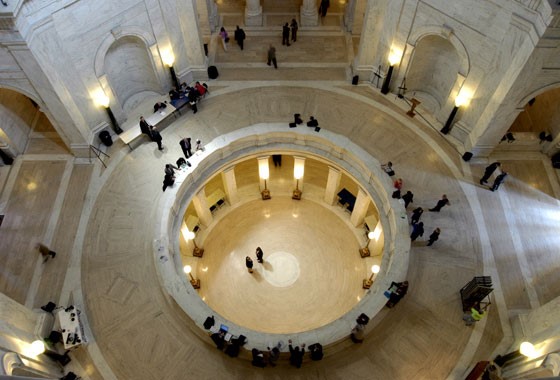
The Well is where conversations happen at the Capitol — where legislators, lobbyists, and staff compare notes, test the mood, and figure out what matters. This briefing is built the same way: a fast, disciplined read on what is moving in West Virginia government before the day begins.
TOP DEVELOPMENTS
Greenbrier refinancing puts casino operations and roughly 90 jobs in jeopardy
The Greenbrier says it must complete a proposed $500 million refinancing with Kennedy Lewis Investment Management by Friday, Aug. 14, even though the West Virginia Lottery has not yet approved the ownership changes affecting the resort’s casino license. The transaction is intended in part to resolve hundreds of millions of dollars in debt involved in the federal receivership dispute with White Sulphur Springs Holdings. Greenbrier attorneys said further delay is adding about $145,000 a day in interest costs and initially told the federal court that the resort would close the casino so the financing could proceed. Approximately 90 casino employees have received WARN notices, although they are to continue receiving pay and benefits during the 60-day notice period.
By Thursday afternoon, however, the resort was seeking a way to avoid an immediate shutdown. Attorney Steve Ruby asked acting Lottery Director David Bradley whether the casino could continue operating temporarily after the refinancing closes while Lottery approval remains pending. Bradley had written that Lottery action on the transaction did not itself require the casino to close and said the commission could potentially consider the ownership change at its Aug. 26 meeting. The Greenbrier says it would accept either a temporary operating agreement or an emergency Lottery meeting; absent either, it says it intends to close the casino while awaiting approval.
What to watch: Whether the refinancing actually closes Friday, whether Lottery permits a transition period that keeps the casino operating, and whether the approximately 90 casino positions ultimately are eliminated. A Friday federal-court status report should clarify the outcome.
Federal investigators identify safety concerns after fatal Institute chemical release
The U.S. Chemical Safety and Hazard Investigation Board said Thursday that its investigation of the April 22 incident at Catalyst Refiners in Institute is focusing on safeguards used while the facility was being decommissioned. Two employees died and 22 people were injured, including four first responders, after a chemical reaction during a transfer into a wastewater receiving tank produced hazardous vapor. Responders detected hydrogen sulfide.
Investigators found four full-face respirators at the site, but the available filters did not protect against hydrogen sulfide, and workers told investigators respirator use was no longer required after decommissioning began. Employees also were not carrying personal gas monitors. The CSB said its continuing investigation will examine chemical incompatibilities, decommissioning hazard analysis, disposal practices, protective equipment, atmospheric monitoring and corporate oversight. The federal agency continues to list the incident as an active investigation.
What to watch: The CSB’s final findings and any recommendations directed to Catalyst Refiners, regulators or the broader chemical industry.
State Supreme Court will hear challenge to legislative oversight of education policy
The West Virginia Supreme Court of Appeals has scheduled Sept. 22 arguments in the state Board of Education’s constitutional challenge to House Bill 2755. The 2025 law requires board policies to go through the Legislative Oversight Commission on Education Accountability and ultimately the Legislature before taking effect.
The board and state Superintendent Michele Blatt contend the requirement infringes on the board’s constitutional authority, relying in part on the court’s 1988 decision in State Board of Education v. Heckler. Secretary of State Kris Warner is the named respondent. Oral arguments are scheduled for 1 p.m. Sept. 22. The case could clarify how far lawmakers may go in supervising policy decisions of the constitutionally created state education board.
What to watch: The court’s treatment of the 1988 precedent and whether HB 2755 remains operative while the litigation proceeds.
STATE, AGENCY & REGULATORY
State Election Commission calls emergency meeting on Glendon Watts candidacy challenge
The West Virginia State Election Commission will hold an emergency meeting Monday, Aug. 17, to consider a request to disqualify candidate Glendon Watts under West Virginia Code §3-5-19(a)(4). The official meeting notice identifies West Virginia Republican Party Chairman Joshua Holstein as the requester.
The agenda calls for a public presentation followed by commission consideration and a vote on the candidate challenge. It also includes review of a campaign-finance matter. The notice was formally accepted Thursday afternoon, placing a new ballot dispute before the commission as election administration continues to generate litigation and candidate-eligibility questions this cycle.
What to watch: The commission’s Aug. 17 vote and any subsequent court challenge.
Tucker County data-center developer supplies DEP with evidence of site control
Fundamental Data LLC has provided the West Virginia Department of Environmental Protection with a 2024 purchase-and-sale agreement covering roughly 290 acres associated with its proposed Tucker County data center and natural-gas-fired microgrid. DEP requested documentation after questions arose over whether the company owned, leased or otherwise controlled the site identified in its air-permit application.
The agreement identifies Western Pocahontas Properties LP as the seller and Fundamental Data as the purchaser, but most of the 18-page document is redacted. Fundamental Data said the withheld material consists of private financial and commercial terms and does not conceal environmental obligations, emissions requirements, monitoring, testing or reporting provisions. The filing is a material new development in a data-center issue covered previously because it directly addresses DEP’s questions about the applicant’s legal control of the proposed site.
What to watch: DEP’s determination on whether the document satisfies its land-control questions and the pending challenges to the project’s air permit.
Supreme Court sets argument in disputed Berkeley County House vacancy
The state Supreme Court also will hear arguments Sept. 22 in the dispute over filling a Berkeley County House of Delegates vacancy created after Joseph de Soto was removed. The case pits West Virginia Democratic Party Chair Mike Pushkin and Stephen Willingham against Gov. Patrick Morrisey and House Speaker Roger Hanshaw.
De Soto changed his voter registration from Republican to Democrat shortly before his arrest. Democrats contend state law requires the replacement to come from the political party with which the former delegate was affiliated when the vacancy occurred; Republicans argue that provision does not control because de Soto had not been sworn into office. Arguments are scheduled for 10 a.m., three hours before the education case.
What to watch: Whether the court defines party affiliation at the time of election, vacancy or assumption of office — a ruling that could affect future legislative vacancies as well as this seat.
DEP approves Clean-Seas air permit for Kanawha County plastics facility
The West Virginia Department of Environmental Protection has approved an air-quality permit for Clean-Seas West Virginia’s proposed plastics-repurposing facility in Quincy, clearing a significant regulatory hurdle for the project at the former 84 Lumber site in eastern Kanawha County. Clean-Seas proposes using pyrolysis to break down waste plastic and convert it into products including fuels, chemicals and material for new plastics. DEP has posted both the final permit and its responses to public comments.
The approval follows substantial local concern over potential emissions and health effects, including objections raised at a DEP meeting in Belle and before the Kanawha County Commission. The Ohio River Valley Institute criticized the permit decision, arguing that DEP weakened pollution safeguards and discounted community concerns. DEP officials have said their role is to determine whether a project complies with environmental permitting requirements, not whether a particular business should locate in the community.
What to watch: Any administrative or court challenge to the permit and Clean-Seas’ timetable for construction and commercial operation.
FEDERAL & WORKPLACE POLICY
Flock announces new privacy safeguards amid nationwide scrutiny of license-plate cameras
Flock Safety is imposing new safeguards on its automated license-plate-reader network after growing criticism over privacy, data sharing and documented cases of law-enforcement misuse. Beginning next year, law-enforcement users will be required to use auditing tools designed to detect abnormal searches and to associate searches with case numbers. Flock also plans to shorten its default license-plate data retention period from 30 days to seven days and give agencies more ability to restrict how information is shared or used for particular categories of enforcement.
The changes are directly relevant in West Virginia, where Flock deployments have generated opposition in Huntington and Monongalia County. Huntington faces an ACLU-backed lawsuit over its $2.1 million Flock contract, while Monongalia County officials have faced repeated public questions about their camera network. Civil-liberties advocates nationally say the company’s changes do not resolve their underlying concern that police agencies can search a broad privately operated surveillance network without prior judicial authorization.
What to watch: How West Virginia agencies using Flock implement the new restrictions, whether they alter pending local contracts or litigation, and whether state lawmakers pursue statutory limits on automated license-plate surveillance.
Mine workers union renews push for enforcement of federal silica protections
The United Mine Workers of America is pressing federal officials to implement and enforce the government’s tighter respirable-crystalline-silica standard for miners, citing new research showing continued severe black-lung disease in central Appalachia. The union says recently published research found black lung in 32.5% of veteran underground miners studied in the region and is calling for stronger ventilation controls, unannounced federal dust sampling and penalties for violations.
The Labor Department’s silica rule lowered the permissible exposure limit to 50 micrograms per cubic meter over an eight-hour shift and requires mine operators to take corrective action when exposures exceed the limit, emphasizing engineering controls, sampling and medical surveillance. Litigation and implementation disputes have delayed full application of the rule in coal mines. NIOSH separately says miners in central Appalachia face particularly serious respiratory-disease risks and that controlling respirable coal and silica dust is central to prevention.
What to watch: Further MSHA or court action affecting when and how the silica standard becomes enforceable in coal mines.
WATCH AHEAD
Monday, Aug. 17: West Virginia State Election Commission emergency meeting on the Watts candidate challenge.
Sept. 22: West Virginia Supreme Court oral arguments in both the Berkeley County House-vacancy dispute and the state Board of Education challenge to HB 2755. |